New York City's Local Law 32, which took effect November 1, 2022, gave the NYC Commission on Human Rights (CCHR) authority to impose civil penalties of up to $500,000 for pay transparency violations. The first enforcement actions have sent a clear signal: the CCHR is not treating this as a technicality. This guide examines what the enforcement record reveals about who gets fined, what violations trigger the largest penalties, and what you can do to avoid becoming a case study.
What NYC Local Law 32 requires
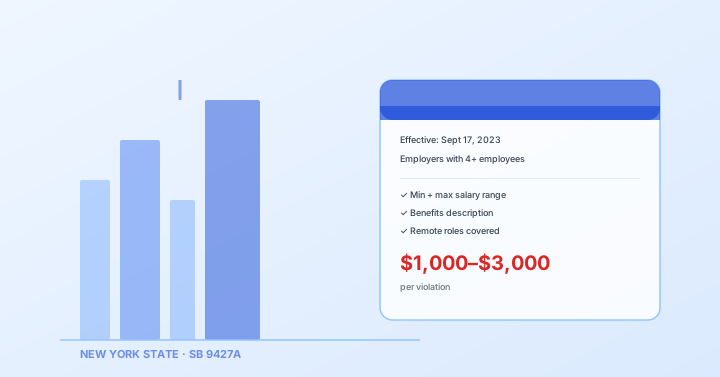
For employers with four or more employees, every NYC job posting must include the minimum and maximum salary or hourly rate for the position. The range must reflect what the employer in good faith believes it will pay. "DOE," "competitive," and "market rate" are not compliant. Each non-compliant posting is a separate potential violation, and the CCHR can impose penalties per-complaint up to $500,000 in aggregate per enforcement action.
The pattern of enforcement
Based on publicly available CCHR enforcement summaries, several patterns emerge:
Volume violations attract the largest penalties
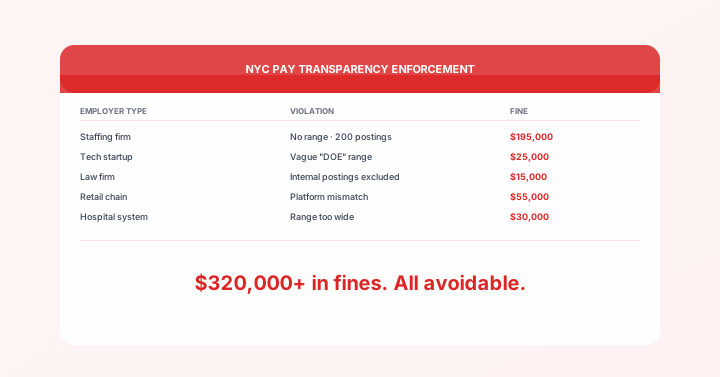
Employers with large job posting volumes who fail to update their entire posting library by the November 2022 effective date face the largest aggregate penalties. A company with 200 non-compliant postings is looking at potential liability of up to $500,000 regardless of individual posting-level fines — because the CCHR aggregates penalties across a single enforcement action.
Good faith matters
Employers who discovered their non-compliance and proactively corrected postings before a formal complaint was filed consistently received lower penalties or no civil penalty. The CCHR has explicitly stated that voluntary correction prior to investigation is a significant mitigating factor. This creates a strong incentive for proactive auditing.
The "below-market range" problem
Some of the most significant enforcement actions have involved employers who posted ranges, but whose actual offers consistently exceeded the posted maximum. This is a good-faith violation — the posted range did not reflect what the employer actually believed it would pay. The CCHR has treated this as more serious than a simple missing-range case, because it involves affirmatively misleading candidates.
Most common violation patterns
- "DOE" or "competitive" language — still appearing in many postings from employers who haven't fully updated templates
- Inconsistency across platforms — careers page has a range; LinkedIn posting for the same role doesn't
- Job board lag — ATS was updated; third-party board still shows old posting without range
- Range set too low — posted range is $70K–$90K but offers are routinely made at $100K–$115K
- Internal transfer postings omitted — NYC law applies to internal opportunities advertised to more than one employee
What the CCHR looks for in an investigation
When the CCHR investigates a complaint, it typically requests:
- A complete list of all job postings during the relevant period, with dates
- The compensation offered to and accepted by hires during that period
- Documentation of your pay transparency compliance policy and training
- Evidence of when you became aware of the law and what steps you took
How to stay off this list
The pattern from enforcement actions is clear: the employers who face large penalties are those who either didn't know about the law or knew about it but treated compliance as optional. The employers who avoid penalties — or receive minimal ones — are those who discovered compliance gaps proactively and corrected them before complaints were filed. Automated daily scanning of your posting library is the lowest-cost way to achieve that proactive posture.