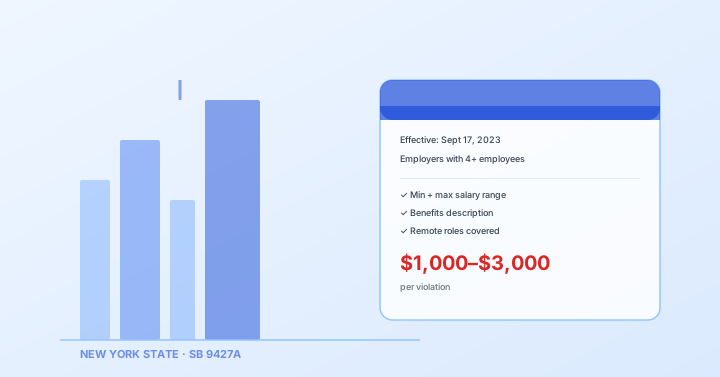
New York State enacted one of the most far-reaching pay transparency laws in the country. Senate Bill 9427A, effective September 17, 2023, requires employers across New York State to disclose compensation ranges in all job postings. This is separate from — and operates alongside — New York City's Local Law 32, which has its own enforcement mechanism and significantly higher penalties.
New York has two layers of pay transparency law:
- New York State (this guide) — SB 9427A, applies statewide including NYC
- New York City Local Law 32 — applies to NYC employers with 4+ employees; maximum aggregate fine $500,000
Who does the New York State law apply to?
NY SB 9427A applies to:
- Employers with four or more employees anywhere (not just in New York)
- Positions that are, or could be, performed in whole or in part in New York State, including remote roles where a NY resident could apply
- Employment agencies posting on behalf of covered employers
What must every job posting include?
- The minimum and maximum annual salary or hourly range that the employer in good faith believes it will pay for the role
- A general description of job benefits (health insurance, 401k, PTO, etc.)
- The above applies to all advertisements for: new job postings, transfers, promotions, and other opportunities
How New York State law differs from NYC Local Law 32
| Requirement | NY State (SB 9427A) | NYC (Local Law 32) |
|---|---|---|
| Employer threshold | 4+ employees | 4+ employees |
| Effective date | Sept 17, 2023 | Nov 1, 2022 |
| Benefits disclosure | Required | Not explicitly required |
| Max penalty | $3,000 per violation | $500,000 aggregate |
| Enforcement | NY Dept of Labor | NYC Commission on Human Rights |
Remote role coverage
If a position can be performed entirely remotely and a New York resident could realistically apply, both NY State and NYC laws apply. Most compliance attorneys advise treating any role posted nationally as covered under New York requirements — the "could be performed in NY" standard is broadly construed.
Employer checklist
- ✓ Include salary/hourly min and max in every posting for NY-applicable roles
- ✓ Include a general description of benefits
- ✓ Review remote postings — if a NY resident could apply, the law applies
- ✓ NYC postings must also comply with Local Law 32
- ✓ Train recruiters not to ask about salary history (prohibited under NY law)
How RoleComply helps
RoleComply identifies New York State and NYC compliance separately and applies the stricter requirement for postings that fall under both laws. It flags missing salary ranges, absent benefits descriptions, and salary history language in posting copy — and tracks law changes automatically so you're always scanning against current requirements.
Frequently asked questions
Does NY State law replace NYC Local Law 32? No. Both laws apply to NYC postings. The state law adds benefits disclosure; the city law has much higher penalties. You must comply with both.
Can I post one range for NY and a different range nationally? You can, but it is administratively complex and can create pay equity concerns. Most employers choose a single range that satisfies all applicable requirements.
What New York State employers must do
The SB 9427A requires employers to include salary ranges in job postings in New York State. The NY State Dept of Labor is the authoritative source for compliance guidance and enforcement updates. Employers with any hiring activity in New York should treat pay range disclosure as non-negotiable.
Audit every active posting. Review all roles advertised in New York State — on your own careers page, LinkedIn, Indeed, Glassdoor, and through any staffing agencies. Every posting needs a salary range. Check that your range is genuine — regulators and candidates alike can identify placeholder-wide ranges that bear no connection to actual pay.
Establish pay bands. A range on a job posting is only defensible if it connects to a documented compensation structure. Build pay bands for each role or level, benchmark against market data, and document the factors that explain variation within each band (experience, skills, location). This documentation protects you in enforcement situations and in employee conversations.
Train your recruiting team. Front-line recruiters need to understand what is required and what is prohibited. "Competitive salary", "DOE", salary history questions, and ranges that do not match the actual hiring budget are the most common violations — and all of them are preventable with basic training and updated posting templates.
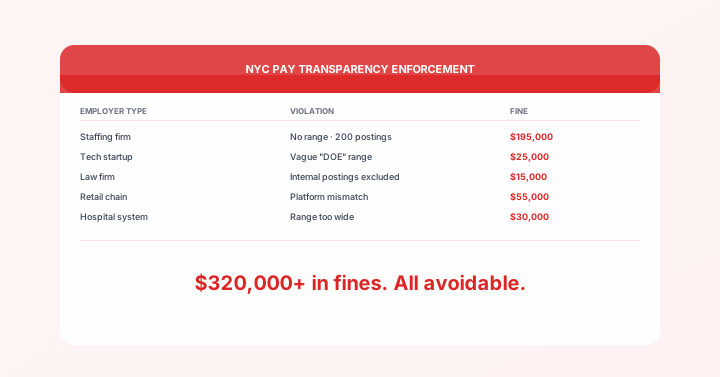
Penalties and enforcement
Enforcement of US pay transparency laws has accelerated since 2023. New York City has issued fines ranging from $15,000 to over $250,000 for single violations. California's Civil Rights Department investigates complaints and requires remediation. The pattern is consistent across jurisdictions: initial enforcement targets large employers with visible non-compliance, then expands to mid-market companies as regulators build capacity. See our US state law roundup for current requirements across all states, or read our salary range best practices guide to learn how to write ranges that satisfy multiple state requirements simultaneously.