New York City's Local Law 32 — also referred to as the NYC Pay Transparency Law — went into effect on November 1, 2022, after a six-month delay from its original May 2022 effective date. It has since become the most actively enforced pay transparency law in the United States, and with a maximum aggregate fine of $500,000, it carries consequences that no employer hiring in New York City can afford to ignore.
What the law requires
Any employer with four or more employees that advertises a job, promotion, or transfer opportunity that can be performed, in whole or in part, in New York City must include a "good faith salary range" in the posting. The range must include a minimum and maximum annual salary or hourly rate.
The law applies regardless of where the employer is headquartered. A San Francisco company posting a remote role that a NYC resident could perform from home is covered by Local Law 32. The DCWP has been explicit on this point since issuing enforcement guidance in March 2023.
Who is covered
The four-employee threshold counts all employees globally, not just those in New York City. A company with three US employees and one international employee is covered if the total reaches four. Temporary staffing agencies are also covered when posting roles on behalf of client employers.
The law covers job postings on: the employer's own careers page, third-party job boards (LinkedIn, Indeed, Glassdoor, ZipRecruiter), internal postings for promotions and transfers, and social media posts describing an open role with application instructions.
The good faith range standard — what it actually means
The DCWP has clarified the good faith standard through enforcement guidance and FAQ updates. A "good faith salary range" must:
- Reflect the compensation the employer genuinely intends to offer for the role
- Have a defined minimum and maximum (not open-ended language like "up to $X")
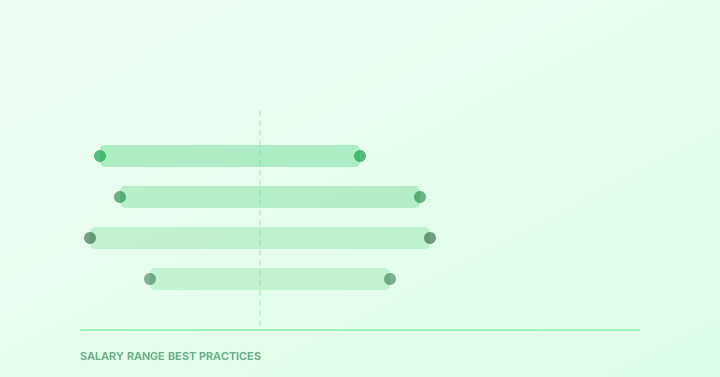
- Not be excessively wide — the DCWP has indicated ranges wider than approximately 35% of the midpoint raise good faith questions
- Be updated if the compensation budget for the role changes significantly after posting
The DCWP explicitly states that "$0 to $1,000,000" is not a good faith range. Neither is "$50,000 to $300,000" for a specific individual contributor role with a defined scope. The range should reflect what you'd actually pay someone who met the job qualifications.
Penalty structure
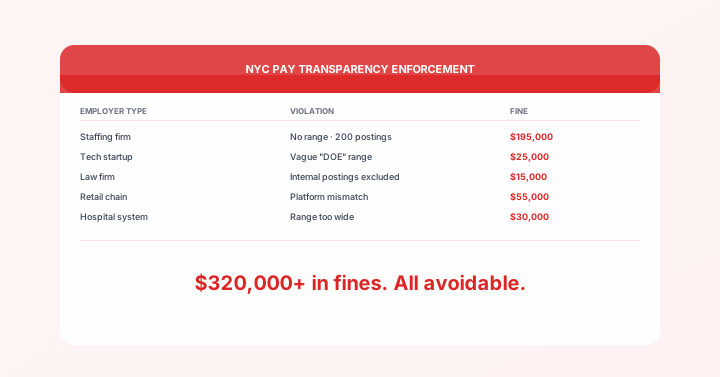
The DCWP's enforcement process typically begins with a complaint or a proactive audit. First violations receive a notice to correct with a 30-day cure period. If the violation is not cured, fines begin at $1,000 per posting for the first violation, increasing to $2,000 for the second, and up to $250,000 per violation for subsequent violations, with a $500,000 maximum aggregate.
In practice, enforcement settlements have been structured as: total fine based on number of non-compliant postings × per-posting rate, reduced if the employer demonstrates corrective action and a compliance plan. A company with 50 non-compliant postings that fails to cure after notice could face a first-cycle settlement of $50,000–$150,000.
Multi-state employers: how Local Law 32 interacts with other state laws
NYC's Local Law 32 sits within New York State's broader pay equity framework, and it interacts with other state requirements for employers posting roles in multiple jurisdictions. Here's how the requirements layer:
- If you already comply with Colorado and Washington (the most demanding US states), you automatically satisfy NYC's requirements — both of those states require salary range plus benefits and bonus, which is more than NYC requires.
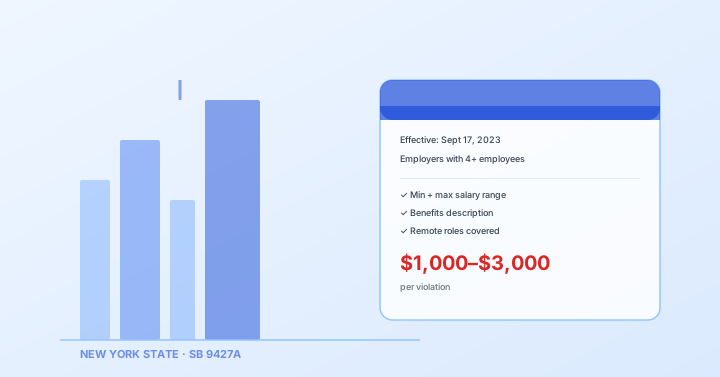
- New York State (outside NYC) passed its own pay transparency law in September 2023, expanding coverage beyond the five boroughs. The state law applies to employers with 4+ employees in New York State for roles that can be performed in New York.
- New Jersey (adjacent metro area): NJ's S2310 applies to employers with 10+ employees. If you're posting roles accessible to both NJ and NYC residents — essentially all NYC metro postings — you need to comply with both.
For employers in the NYC metro area, the universal approach is simplest: include salary ranges, benefits descriptions, and bonus information on every single posting, everywhere. This satisfies Local Law 32, New York State, New Jersey, Colorado, Washington, and every other active jurisdiction simultaneously. See our salary range best practices guide for how to structure compliant ranges.
What about EEO and OFCCP requirements?
Local Law 32 focuses specifically on salary disclosure. But most NYC employers are also subject to federal requirements: EEO statements, ADA accommodation language, and — if you're a federal contractor — OFCCP requirements. A fully compliant NYC job posting needs all of these elements, not just the salary range. See our EEOC compliance guide and OFCCP checklist for details on what else your postings need.
Common mistakes and how to avoid them
Forgetting remote roles. The most common enforcement issue. A posting on your careers page marked "Remote - US" with no geography restriction is a NYC posting under Local Law 32.
ATS syndication stripping the range. Many applicant tracking systems don't automatically carry salary range data to syndicated job board postings. Verify that ranges appear on your Indeed, LinkedIn, and Glassdoor postings — not just your careers page. See our recruitment marketing compliance guide for a full breakdown of syndication gaps.
Using "competitive salary" language. Flatly non-compliant. Even as a supplement to a disclosed range, phrases like "competitive" or "market rate" add nothing legally and signal opacity to candidates.
Not updating ranges when budgets change. If you posted a role at $80K–$100K and the budget has shifted to $90K–$120K three months later, the posting should be updated. The good faith standard applies to the posting's current state, not its initial state.
How to audit your existing postings
If you haven't audited your NYC-accessible job postings for Local Law 32 compliance, now is the time. Start with:
- Pull every active posting from your ATS and careers page
- Flag all national or NYC-accessible remote roles
- Check each for: salary range present, range is genuine (not 0–$500K), range includes both minimum and maximum
- Verify the ranges appear on syndicated versions (Indeed, LinkedIn, Glassdoor)
- Update any non-compliant postings within 48 hours of identification
RoleComply automates this process — scanning every posting daily and flagging Local Law 32 violations before they become enforcement actions.