Most employers frame pay transparency compliance as a legal risk: catch the violation, pay the fine, move on. But the real cost of non-compliance goes much deeper than the penalties — and for most organisations, the fine is actually the smallest part of the problem.
The direct fine exposure
Let's start with what everyone focuses on. Fines for pay transparency violations range from $500 per posting (Colorado, Washington, Vermont) to $10,000 per posting (California, Illinois) to a maximum aggregate of $500,000 (New York City). For a company with 50 open roles all missing salary ranges, the theoretical exposure in California alone is $500,000.
In practice, first-offence fines are typically lower — regulatory agencies have described "graduated penalty schedules" that start in the low thousands and escalate with repeat violations. But the DCWP in New York City has already issued six-figure settlements to employers who ignored initial notices. The enforcement environment has hardened significantly since 2023.
The recruiting funnel cost — usually larger than the fine
Here's the number most compliance teams don't calculate: the cost of reduced application volume caused by missing salary ranges. Three independent surveys in 2024–2025 (LinkedIn Talent Solutions, Indeed, and SHRM) all found the same thing — 70–75% of candidates are less likely to apply when a salary range is absent from a posting.
Let's model this for a mid-sized employer with 40 open roles at any given time, using conservative assumptions:
- Average cost per hire: $4,700 (SHRM 2024 benchmark)
- Extended time-to-fill due to fewer applicants: 3 weeks average
- Additional sourcing spend per role: $800 (job board boosts, LinkedIn InMail)
- Vacancy cost (lost productivity): $1,200/week per role
For 40 roles × 3 extra weeks × $2,000 additional cost per week per vacancy, the annual recruiting funnel cost of non-compliance is approximately $240,000 — and that's before accounting for agency fees on hard-to-fill roles that took even longer.
Job board visibility loss
This is the mechanism behind the funnel cost: LinkedIn, Indeed, and Glassdoor all deprioritise postings without salary ranges in their search algorithms. LinkedIn's "All Filters" salary filter entirely excludes non-range postings. Indeed's "Salary Estimate" indicator becomes unavailable. The practical effect is that compliant postings get 2–3× more visibility on filtered searches — which is how most active candidates search.
When you combine the algorithmic deprioritisation with the candidate behaviour data (3 in 4 candidates less likely to apply), the recruiting impact is substantial and permanent for as long as you remain non-compliant.
Legal cost: the hidden multiplier
When an agency investigation begins, the direct fine is only part of the cost. Regulatory investigations require internal resources to respond to document requests, legal counsel to manage the process, and often result in broader pay equity audits being triggered. A $5,000 NJDOL fine can easily result in $50,000–$150,000 in total legal and operational cost when the full investigation process is included.
Class action exposure is also relevant — particularly in California, where PAGA (Private Attorneys General Act) allows employees to bring representative actions for pay transparency violations. Several PAGA actions related to pay transparency were filed in 2024–2025 with settlement demands in the $500,000–$2 million range.
The employer brand damage — long-tail and hard to reverse
Employer review platforms (Glassdoor, Blind, LinkedIn) now commonly feature complaints about missing salary ranges. Job seekers share non-compliant postings on social media. Recruiters at agencies will informally advise candidates away from companies known for opacity on compensation.
This brand damage is particularly damaging for technology employers competing for senior engineering and product talent — exactly the roles where salary ranges are most commonly missing and where candidate leverage is highest. Unlike a fine, employer brand damage compounds over time and is costly to reverse.
The ROI of compliance
The business case for proactive compliance is overwhelming when you model it correctly. RoleComply's annual cost for a 50-role employer is $2,868 (Growth plan, annual). The avoided costs — reduced fine exposure, recruiting funnel improvement, legal cost avoidance, brand protection — are conservatively 50–100× that figure.
The companies that treat pay transparency as a compliance burden are looking at it backwards. Done well, it's a talent acquisition advantage. Candidates actively seek out employers who post salary ranges. In a competitive talent market, transparency is a differentiator.
How to close the gap quickly
For most employers, achieving full compliance requires three things:
- Salary band documentation: Every role needs an approved compensation range before a compliant posting can be written. If your compensation architecture is incomplete, this is the first priority — typically 4–8 weeks of HR and finance work for a 200-person organisation.
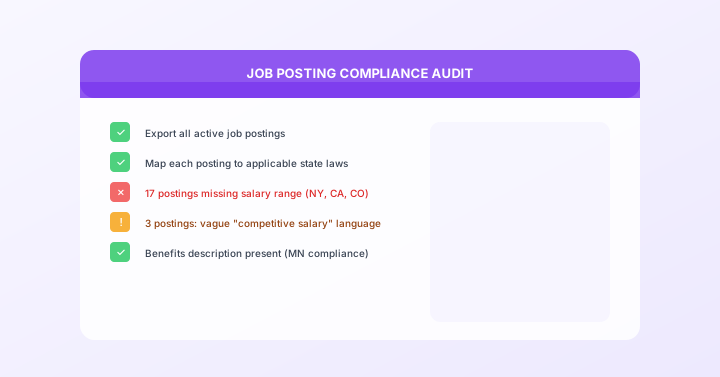
- Job posting audit: Run a full audit of all live postings against active state laws. See our salary range best practices guide for what each state requires.
- Ongoing monitoring: New roles are posted daily; laws change quarterly. Manual compliance doesn't scale — and the companies with ongoing violations are almost always ones relying on periodic manual audits rather than continuous monitoring.
For most employers, closing the compliance gap takes 6–8 weeks from the point of decision. The regulatory and recruiting cost of delay is rarely worth the time saved.