More than 30 US states now have some form of pay transparency or salary history ban legislation. The European Union made pay transparency mandatory for all member states by June 2026. Against this backdrop, the question of whether the United States will enact a federal pay transparency law is no longer abstract — it's a matter of timing, not direction. Here's where things stand and what the signals point toward.
The current federal landscape
There is no federal law requiring salary ranges in job postings as of 2026. The existing federal framework for pay equity is anchored in older legislation:
- Equal Pay Act (1963): Requires equal pay for substantially equal work across genders — but says nothing about disclosure
- Title VII of the Civil Rights Act (1964): Prohibits pay discrimination based on protected characteristics but does not mandate transparency
- Lilly Ledbetter Fair Pay Act (2009): Extended the statute of limitations for pay discrimination claims — again, not a transparency requirement
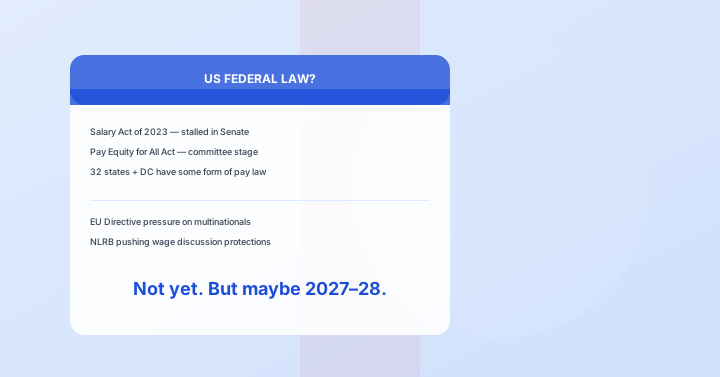
Bills have been introduced in Congress — notably the Salary Transparency Act and the Pay Equity for All Act — but none have advanced to a floor vote. The political calculus is complex: while pay transparency has broad public support, business lobbying groups have successfully argued against federal mandates.
The signals pointing toward federal action
Several converging forces suggest federal legislation is a matter of when, not whether:
- State-level momentum is overwhelming: When a majority of states pass similar legislation, federal standardisation becomes politically easier. Businesses operating in 15+ regulated states increasingly prefer a single federal standard to a patchwork of 50 different rules.
- EU Directive pressure: Multinational companies headquartered in the US but operating in Europe must comply with EU pay transparency requirements. Once systems and processes are in place for EU compliance, US federal adoption becomes simpler.
- Labour market data: Studies consistently show that salary range disclosure reduces gender pay gaps and increases candidate application rates. This evidence base strengthens the case for federal action.
- NLRB enforcement: The National Labour Relations Board has increasingly enforced employees' right to discuss wages — a foundational element of transparency culture even without specific posting requirements.
What federal legislation might look like
Based on the introduced bills and state law patterns, a federal pay transparency law would likely:
- Apply to employers with 15 or more employees (mirroring Title VII thresholds)
- Require salary range disclosure in job postings, not merely upon request
- Prohibit salary history inquiries federally (currently banned in 21 states)
- Include pay data reporting requirements for larger employers (modelled on California's CRD reporting)
- Be enforced by the EEOC or a newly empowered Department of Labor division
Realistic timeline
The most credible scenarios for federal action:
- 2025–2026: Unlikely. Legislative bandwidth is consumed by other priorities and business lobbying remains effective
- 2027–2028: More plausible if Democrats regain Senate control or if bipartisan business support for a single federal standard emerges
- Post-2028: Increasingly likely regardless of political composition, as the state patchwork becomes untenable for large employers
What employers should do now
The uncertainty cuts both ways. Employers who build compliant posting processes today — handling all 15+ active US states — will have almost no additional work to do when federal law passes. The infrastructure is the same; only the mandate changes. Build for the future now: it's both ethically aligned and strategically sound.
What this means in practice
The shift to pay transparency is not just a legal requirement — it is a structural change in how employers and candidates interact. Research from the US Department of Labor and LinkedIn consistently shows that job postings with salary information receive significantly more applications, better-qualified candidates, and higher offer acceptance rates. The business case for transparency is as strong as the compliance case.
Employers who approach pay transparency strategically — not just by adding numbers to job postings but by building the compensation infrastructure that makes those numbers meaningful — consistently outperform those who treat it as a box to tick. The key elements of that infrastructure are: documented pay bands tied to roles and levels, external market benchmarking updated at least annually, clear criteria for where within a band an individual sits, and a regular pay equity audit to identify and remediate unexplained gaps.
The organisations getting the most value from pay transparency are those using it as the forcing function to fix compensation practices they knew were inconsistent but had not prioritised. The external disclosure requirement creates the internal discipline to get it right.
Further reading
To build a comprehensive understanding of pay transparency compliance and strategy, these resources cover the key areas:
- Pay transparency 101 — the fundamentals for HR teams
- Salary range best practices — how to write ranges that work across jurisdictions
- Job posting compliance audit — a step-by-step audit process
- US state law roundup — current requirements in every US state
- EU Pay Transparency Directive explained — the full EU framework
Start a free trial of RoleComply to automate pay transparency compliance across all your job postings.