Five new states activated pay transparency requirements in 2025 — Illinois, Minnesota, New Jersey, Vermont, and Maryland. The pace isn't slowing. Based on legislative activity, political signals, and demographic patterns from states that have already acted, these are the jurisdictions most likely to pass pay transparency laws in 2026 and 2027.
The pattern: how state adoption works
Pay transparency laws tend to pass in clusters, and the pattern is predictable. States that have already passed legislation are overwhelmingly: Democrat-controlled legislatures, coastal or Great Lakes geography, high median household income, and large professional and tech employment sectors. When a neighbouring state passes a law, the pressure on adjacent states increases. New York's 2023 law accelerated Connecticut's expansion; Colorado's 2021 law influenced Washington's 2023 law.
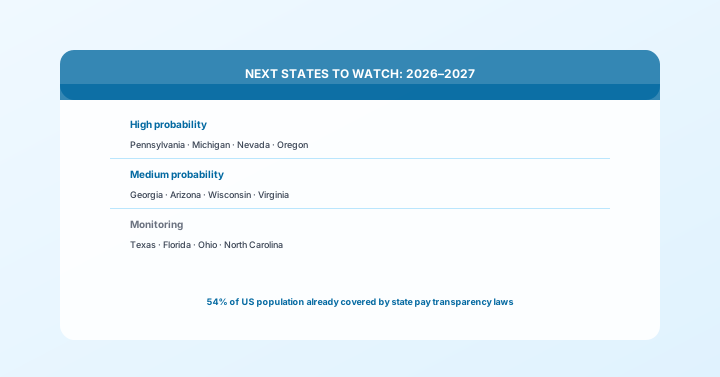
High probability: 2026–2027
Pennsylvania
Pennsylvania has had pay transparency bills introduced in multiple legislative sessions. With a Democratic governor and a narrowly divided legislature, a bill covering Philadelphia and Pittsburgh metro employers — and potentially statewide — is the most plausible near-term path. The Philadelphia area's large financial services and healthcare employment base gives the bill significant political support.
Michigan
Michigan's Democratic trifecta since 2022 has passed significant employment law reforms. Pay transparency legislation has been introduced and has union backing — a particularly significant factor in a state where organised labour retains political influence. Watch for a law with a low employer threshold, likely 5–15 employees.
Nevada
Nevada has a salary history ban in place and is one step away from a full pay transparency posting requirement. With a large hospitality sector where wage transparency is increasingly expected by workers, the political conditions are favourable. A 2026 law is plausible.
Oregon
Oregon already has a salary history ban. The Oregon legislature has considered pay transparency bills and the state's political composition makes a posting requirement likely within the 2026–2027 window.
Medium probability: 2026–2028
Virginia
Virginia's status as a purple state with a growing tech corridor in the DC suburbs creates conditions for pay transparency legislation. The Northern Virginia tech cluster is already subject to Maryland's law for postings accessible to Maryland residents — Virginia employers are increasingly familiar with the concept.
Georgia
Georgia's growing tech and financial services sectors in Atlanta, and a politically divided state government, make pay transparency a harder but not impossible legislative path. Atlanta's corporate community increasingly sees pay transparency as a talent attraction tool.
Arizona and Wisconsin
Both states have introduced pay transparency legislation but face Republican-controlled legislative chambers. Movement in these states most likely follows a change in legislative control or a federal law that makes state-level action redundant.
States to monitor: lower near-term probability
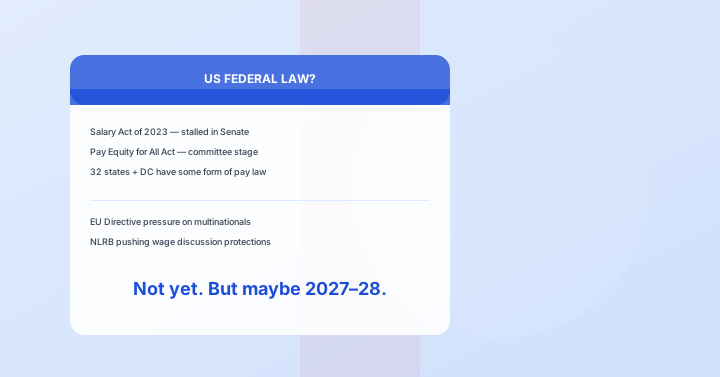
Texas, Florida, Ohio, and North Carolina have introduced minimal pay transparency legislation and have Republican-controlled legislatures with stated opposition to new employment mandates. These states are more likely to await federal action than to pass state-level laws. That said, employers in these states who post remote roles accessible to residents of regulated states are already affected.
What this means for your compliance programme
The practical implication: if you're already compliant with the 15 active state laws, adding four or five more states to your covered list is a minor incremental change. Build the infrastructure now. The marginal cost of adding a new state to an existing compliance programme is close to zero; the cost of building from scratch after a law passes is much higher.
What this means in practice
The shift to pay transparency is not just a legal requirement — it is a structural change in how employers and candidates interact. Research from the NCSL Pay Transparency Laws tracker and LinkedIn consistently shows that job postings with salary information receive significantly more applications, better-qualified candidates, and higher offer acceptance rates. The business case for transparency is as strong as the compliance case.
Employers who approach pay transparency strategically — not just by adding numbers to job postings but by building the compensation infrastructure that makes those numbers meaningful — consistently outperform those who treat it as a box to tick. The key elements of that infrastructure are: documented pay bands tied to roles and levels, external market benchmarking updated at least annually, clear criteria for where within a band an individual sits, and a regular pay equity audit to identify and remediate unexplained gaps.
The organisations getting the most value from pay transparency are those using it as the forcing function to fix compensation practices they knew were inconsistent but had not prioritised. The external disclosure requirement creates the internal discipline to get it right.
Further reading
To build a comprehensive understanding of pay transparency compliance and strategy, these resources cover the key areas:
- Pay transparency 101 — the fundamentals for HR teams
- Salary range best practices — how to write ranges that work across jurisdictions
- Job posting compliance audit — a step-by-step audit process
- US state law roundup — current requirements in every US state
- EU Pay Transparency Directive explained — the full EU framework
Start a free trial of RoleComply to automate pay transparency compliance across all your job postings.