Despite best efforts, pay transparency enforcement inquiries happen. A candidate complaint, a random audit, or a former employee's tip to a state agency can trigger a regulator contact. This guide covers exactly what to do — and what not to do — when that happens.
Step 1: Stay calm and do not respond immediately
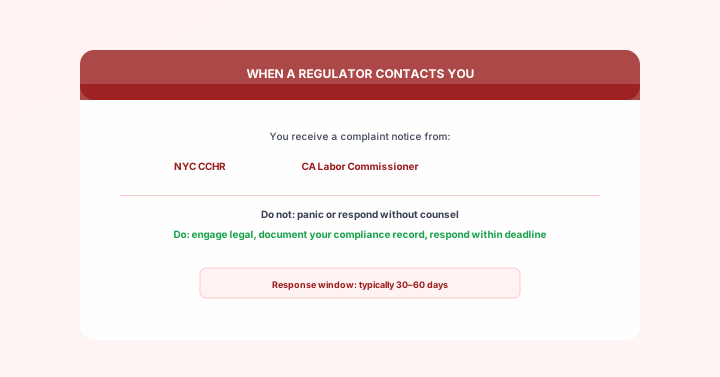
The most important thing when you receive a complaint notice or inquiry letter is not to respond reflexively. State regulators typically give employers 30 to 60 days to respond, and a hasty or incomplete response can make matters worse. Read the notice carefully and document:
- Which agency sent it (NYC Commission on Human Rights, California DLSE, Colorado CDLE, etc.)
- Which specific posting or conduct the complaint relates to
- The stated deadline for your response
- What you're being asked to provide (a written explanation? Documentation? Access to records?)
Step 2: Engage employment legal counsel immediately
Do not respond to a regulatory inquiry without involving legal counsel. Even if the complaint appears minor or unfounded, a misstep in your response can create larger liability. Your counsel should:
- Review the relevant state law and the specific posting in question
- Advise on the appropriate scope of your response (don't over-disclose)
- Draft or review your formal response before it goes out
- Advise whether proactive remediation (correcting the posting, paying a civil penalty) is in your interest
Step 3: Gather your compliance documentation
The strength of your defence depends on what documentation you have. Collect:
- The job posting as it appeared on the relevant date (archive or screenshot)
- Your pay transparency policy as of that date
- Any recruiter training records showing the team was trained on the requirements
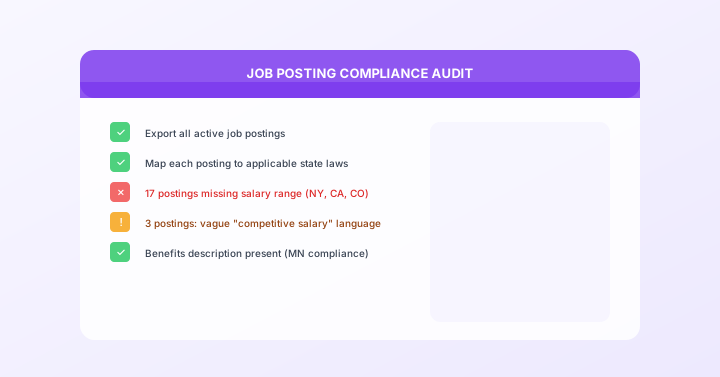
- Evidence that you had a compliance process in place (e.g. RoleComply audit logs showing the posting was reviewed)
- Payroll records or offer letters if the complaint relates to an actual hire
Step 4: Assess the specific violation
Regulators typically cite one of a few specific issues. Each has different remediation logic:
- Missing salary range: Correct the posting immediately. In states like Hawaii, correcting a first offense before enforcement can eliminate the penalty entirely.
- Vague compensation language ("competitive salary"): Replace with a genuine range. Consider whether the existing range is actually posted on any version of the job ad.
- Salary history inquiry: Assess whether and how the inquiry occurred, who made it, and whether compensation decisions were actually influenced by it.
- Missing EEO statement: Correct and document. Often the easiest violation to remediate quickly.
Step 5: Respond within the deadline — thoughtfully
Your formal response should typically include:
- A factual description of your compliance programme
- Evidence that the posting was compliant (if you believe it was), or acknowledgment of the violation and steps taken to correct it
- A description of your pay transparency policy and training
- Any mitigating factors (first offense, immediate correction, good faith compliance effort)
Do not make admissions beyond what the evidence clearly shows. Do not submit the response without counsel's review.
After the investigation: systematic remediation
Whether the investigation closes with or without penalty, use it as an impetus to strengthen your compliance programme:
- Audit all other postings for the same issue
- Identify the root cause — was it a template problem, a training gap, or a system limitation?
- Update training to include the scenario that led to the complaint
- Consider automated scanning to prevent recurrence
What this means in practice
The shift to pay transparency is not just a legal requirement — it is a structural change in how employers and candidates interact. Research from the EEOC Employer Guidance and LinkedIn consistently shows that job postings with salary information receive significantly more applications, better-qualified candidates, and higher offer acceptance rates. The business case for transparency is as strong as the compliance case.
Employers who approach pay transparency strategically — not just by adding numbers to job postings but by building the compensation infrastructure that makes those numbers meaningful — consistently outperform those who treat it as a box to tick. The key elements of that infrastructure are: documented pay bands tied to roles and levels, external market benchmarking updated at least annually, clear criteria for where within a band an individual sits, and a regular pay equity audit to identify and remediate unexplained gaps.
The organisations getting the most value from pay transparency are those using it as the forcing function to fix compensation practices they knew were inconsistent but had not prioritised. The external disclosure requirement creates the internal discipline to get it right.
Further reading
To build a comprehensive understanding of pay transparency compliance and strategy, these resources cover the key areas:
- Pay transparency 101 — the fundamentals for HR teams
- Salary range best practices — how to write ranges that work across jurisdictions
- Job posting compliance audit — a step-by-step audit process
- US state law roundup — current requirements in every US state
- EU Pay Transparency Directive explained — the full EU framework
Start a free trial of RoleComply to automate pay transparency compliance across all your job postings.