The compliance landscape for job advertising has traditionally been managed by HR and legal teams focused on the careers page. But as recruitment marketing has evolved into a sophisticated, multi-channel function — with paid social, employer branding content, programmatic job distribution, and agency partnerships all contributing to hiring — the compliance surface has expanded dramatically. Most recruitment marketing teams don't know they're managing compliance risk. Most HR compliance teams don't know what their marketing colleagues are posting.
Paid social and boosted job postings
A job posting boosted as a sponsored advertisement on LinkedIn, Indeed, or Instagram carries precisely the same pay transparency compliance obligations as the organic posting. This seems obvious in retrospect but is consistently missed in practice. The typical failure mode: HR posts a compliant version on the careers page, the marketing team or a recruiter creates a social ad for the same role without including the salary range (because the ad format is shorter), and the non-compliant ad runs to thousands of impressions before anyone notices.
LinkedIn's sponsored job content is explicitly covered by New York City's Local Law 32 enforcement guidance and California's DFEH guidance. The DCWP has issued enforcement letters to employers whose Instagram and LinkedIn ads described open roles without salary ranges. The medium doesn't change the requirement — if it describes an open role and invites applications, it's a job posting under most active state laws.
Practical fix: build salary ranges into your social job content template as a required field, not an optional addition. Add a compliance review step to your paid social job ads before they go live.
ATS syndication: the hidden gap
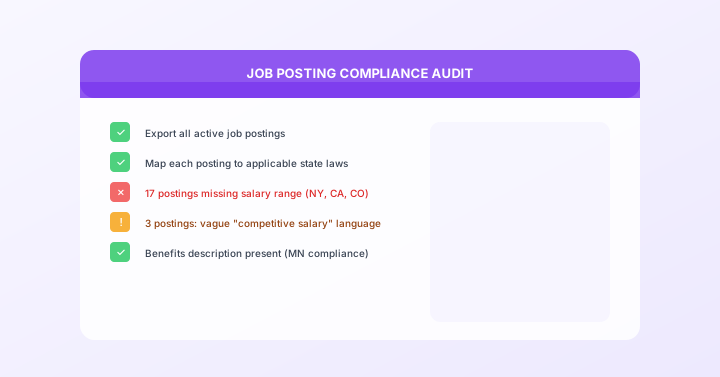
The most common and least visible compliance gap in recruitment marketing is ATS syndication. Many employers post compliant job descriptions — with salary ranges, benefits descriptions, and all required elements — on their careers pages. What they don't realise is that their ATS is syndicating a stripped-down version to LinkedIn, Indeed, Glassdoor, and ZipRecruiter that omits the salary range entirely.
This happens because: (1) many ATS platforms have separate salary range fields that need to be explicitly mapped to syndication outputs, (2) some older ATS platforms don't have pay transparency-specific fields at all, requiring workarounds, and (3) job board integrations may have been configured before pay transparency requirements applied and never updated.
The result: your careers page is compliant; your major job board postings aren't. Since most candidates actually see your postings on job boards rather than directly on your careers page, this means most of your candidates are seeing non-compliant versions — and regulators auditing job boards will see the non-compliant versions too.
ATS-by-ATS breakdown
Greenhouse: Has native pay transparency fields that syndicate correctly to all major job boards when configured. Requires explicit configuration of the salary range fields — they don't auto-populate from job description text.
Lever: Native salary range fields syndicate to LinkedIn and Indeed correctly. Manual configuration required; verify in your account settings.
Ashby: Strong pay transparency support with automatic prompting to include salary ranges. Generally the most reliable for compliance syndication.
Workday: Pay range field exists but is not universally mapped to syndication outputs in all configurations. Requires explicit testing of syndicated postings — don't assume the careers page configuration carries through.
iCIMS, Taleo, and older enterprise platforms: Variable support for salary range syndication. Manual verification of all syndicated postings is necessary. Some configurations require the salary range to be included in the job description body rather than a separate field for it to appear on job boards.
Social media employer branding and job teasers
LinkedIn posts describing an open role and inviting candidates to apply, Instagram employer brand stories featuring job opportunities, and even informal Twitter/X posts from recruiters about open roles can constitute job postings under active pay transparency laws. Colorado's CDLE and California's DFEH have both issued guidance indicating that social content describing an open role with application instructions is covered by pay transparency requirements.
This doesn't mean every LinkedIn post mentioning your company's culture is a regulated posting. The trigger is: (1) describes a specific open role, (2) invites applications or directs readers to apply. A post that says "We're hiring Senior Engineers — check out our careers page!" without a salary range may technically require a range if it meets this two-part test.
Practical guidance: for any social content that describes a specific open role and invites applications, include a salary range. This is also a talent acquisition best practice — candidates on social media are even more likely than candidates on job boards to appreciate seeing compensation upfront.
Agency and RPO compliance obligations
Third-party recruiting agencies and RPO providers posting roles on your behalf have pay transparency obligations that parallel your own — and in many jurisdictions, including New Jersey, the agency is independently liable for non-compliant postings in addition to the client employer. Your agency contracts should include pay transparency compliance warranties. Specifically:
- Agency agrees to include pay range information provided by client on all postings
- Agency agrees not to post client roles without pay ranges in states with active requirements
- Agency agrees to include required EEO and ADA language on all postings
- Agency maintains documentation of posting compliance for the client's record-keeping requirements
For RPO arrangements where the agency has broader control over the posting process, a formal compliance review process is necessary — not just a contractual provision.
Programmatic job advertising
Programmatic job advertising platforms (Appcast, Recruitics, Joveo, and similar) distribute job postings automatically across a network of job sites based on targeting parameters. When postings are distributed programmatically, the compliance obligations don't disappear — they just become harder to monitor because the postings appear across dozens of sites you may not be actively tracking.
Before running programmatic campaigns: verify that salary ranges are included in the job content being distributed, check that your programmatic platform is using the correct version of each posting (not a stripped API version), and establish a monitoring process to spot-check postings across the distribution network periodically.