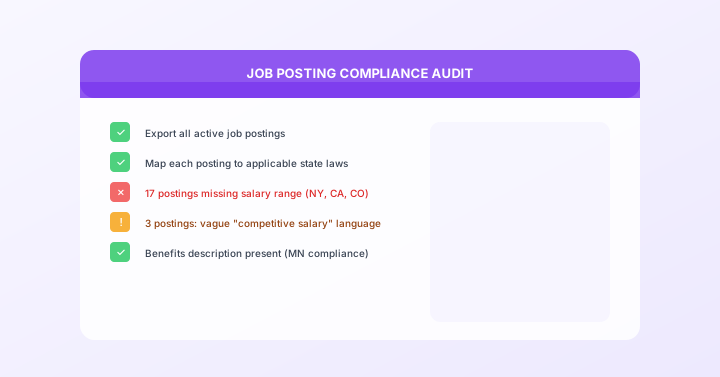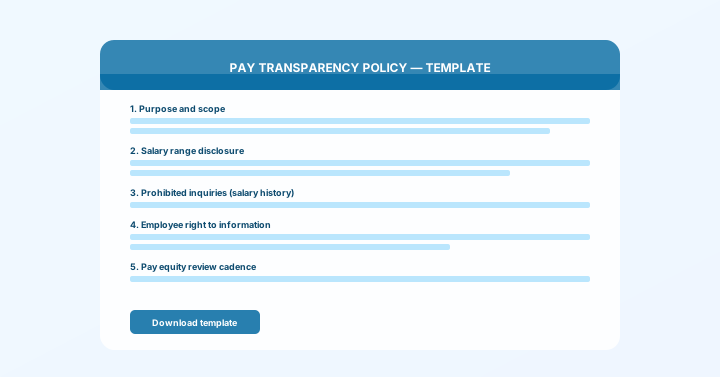
Pay transparency compliance has a compliance framing and a talent framing. Most HR and legal teams focus entirely on the compliance framing — what's the fine, what's the law, are we covered? But the more significant business case for transparency often comes from the talent side: what does non-compliance actually cost in terms of candidates, quality of hire, and employer brand?
The candidate expectation shift — what the data shows
Three separate surveys published between 2024 and 2025 converged on the same finding: approximately 70–75% of candidates are less likely to apply to a job posting when a salary range is absent. The surveys — from LinkedIn Talent Solutions, Indeed, and SHRM — used different methodologies but reached similar conclusions. This is not a marginal effect. It's a fundamental change in candidate behaviour driven by six years of exposure to salary-transparent postings in states like Colorado and California.
The mechanism is straightforward. Candidates who have grown accustomed to seeing salary ranges now treat a missing range as a signal. The most common interpretation, according to qualitative research from Glassdoor's employer brand team: "the employer knows their rate is below market and doesn't want candidates to self-select out." Even if this isn't true, it's what a significant portion of your candidate pool believes when they see a posting without a range.
Job board visibility: the algorithmic penalty
The second mechanism is less intuitive but equally significant. LinkedIn, Indeed, and Glassdoor all incorporate salary data into their search relevance algorithms. Postings with disclosed salary ranges appear higher in filtered searches, receive more prominent display in "salary" search categories, and are included in email alerts for candidates who have set salary filters.
The practical effect: a compliant posting for a Senior Engineer at $140K–$170K will receive substantially more visibility than an identical non-compliant posting on every major job board. LinkedIn's own data suggests that salary-range postings receive 2–3× more applications on filtered searches compared to non-range postings in the same category.
Quantifying the recruiting funnel cost
To make the business case concrete, consider a mid-sized employer with 40 open roles at any given time. Using conservative industry benchmarks:
- 30% reduction in qualified applications due to missing salary ranges (conservative; surveys suggest 50–70%)
- $4,700 average cost-per-hire (SHRM 2024)
- 3-week average additional time-to-fill due to smaller applicant pool
- $1,400/week vacancy cost per role (productivity loss + overhead allocation)
Annual additional recruiting cost: 40 roles × 3 weeks × $1,400 = $168,000 in vacancy costs alone, before increased sourcing spend or agency fees on hard-to-fill roles. For most mid-market employers, this dwarfs the fine exposure from state pay transparency laws.
See our full cost of non-compliance analysis for a complete model of the financial exposure including fines, legal costs, and brand damage.
The employer brand dimension
Employer brand damage from pay opacity is slower to accumulate than recruiting funnel loss, but harder to reverse. It shows up in four ways:
Review platform complaints. Glassdoor, Blind, and LinkedIn reviews now routinely mention missing salary ranges as a negative signal. A pattern of such reviews in a company's profile affects candidates early in their research phase — before they even reach your careers page.
Social sharing of non-compliant postings. Job seekers share non-compliant postings on Reddit's r/jobs, LinkedIn, and Twitter/X as examples of employers to avoid. These posts can attract significant engagement and remain searchable for years.
Agency and recruiter informal guidance. Recruiters at staffing agencies informally advise candidates about employer compensation practices. Agencies that have placed candidates at companies known for lowball offers or opacity will direct candidates elsewhere, particularly for hard-to-fill roles.
Community and professional network signalling. In tight professional communities — engineering, finance, healthcare — word spreads quickly about which employers are transparent and which aren't. This is impossible to quantify but very real in competitive talent markets.
Transparency as a competitive advantage
The companies that have adopted salary transparency proactively — ahead of legal requirements — report consistent improvements in application quality, time-to-fill, and offer acceptance rates. Buffer, Whole Foods (for hourly roles), and several large technology companies have made full salary transparency a deliberate employer brand strategy, not just a compliance exercise.
For most employers, the achievable version of this is simpler: post salary ranges, keep them accurate, and make the ranges genuinely competitive. This doesn't require publishing every employee's salary — it requires only that your job postings tell candidates what they'd be paid if hired. The employers who do this consistently and accurately develop a reputation for fairness that compounds over time.
What "getting it right" looks like operationally
The employers who use pay transparency as a talent advantage share a few operational practices. First, they treat salary bands as a posting prerequisite — no posting goes live without an approved range. Second, they keep ranges current: if the market has moved or the hiring budget has changed, the posted range is updated within a week, not left stale for months. Third, they train their recruiters to discuss compensation openly early in the process rather than deferring until offer stage. Fourth, they use best-practice salary range formatting — specific, genuine ranges rather than $50K–$200K placeholders. These practices together create a recruiting experience that candidates actively seek out and reference positively in reviews.