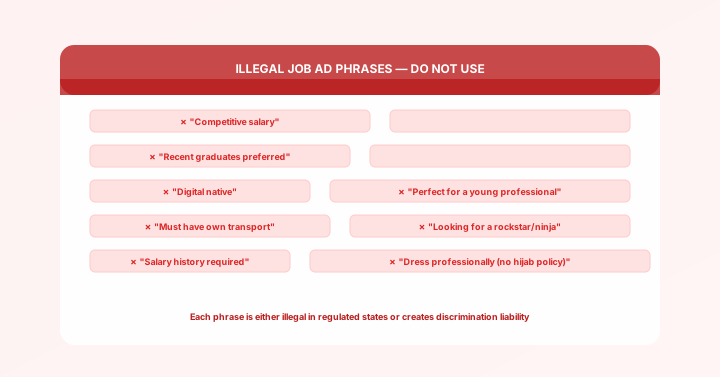
Compliance and discrimination risks in job ads don't always come from obvious places. Some of the most common job ad phrases — used in millions of postings today — either violate specific state pay transparency laws, run afoul of EEOC guidance on discriminatory language, or both. Here are ten phrases you should remove immediately, with explanation of why each is problematic and what to write instead.
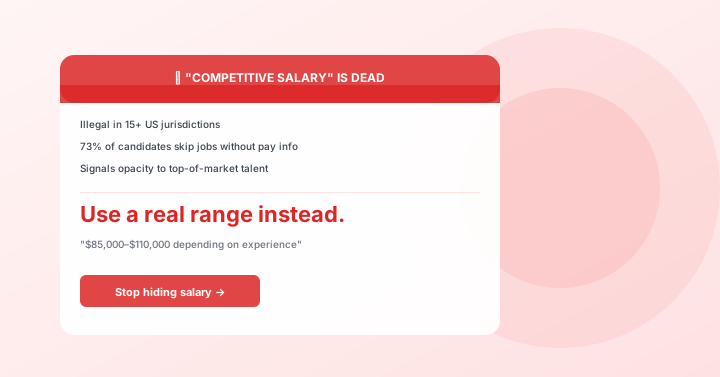
- #1: "Competitive salary"
- #2: "DOE" / "Depends on experience" / "Salary commensurate with experience"
- #3: "Recent graduates preferred" / "New grad opportunity"
- #4: "Native English speaker" / "Native fluency required"
- #5: "Digital native"
- #6: "Rockstar" / "Ninja" / "Guru" / "Wizard"
- #7: "Salary history required" / "Please include current compensation"
- #8: "Must be able to lift 50 pounds" (when it's not actually required)
- #9: "Must have own transport" / "Must have a car" (when public transit is available)
- #10: "Clean background required" / "No criminal history"
#1: "Competitive salary"
Why it's a problem: Illegal in California, New York, Colorado, Washington, Illinois, New Jersey, Minnesota, Maryland, Connecticut, Vermont, Hawaii, and all EU member states from June 2026. These jurisdictions require an actual salary range, not a vague claim.
Write instead: "The salary range for this role is $X to $Y annually."
#2: "DOE" / "Depends on experience" / "Salary commensurate with experience"
Why it's a problem: Same as above — these are not salary ranges. They're evasions. Every active state pay transparency law requires a minimum and maximum, not an open-ended commitment.
Write instead: A specific range. If compensation varies with experience, the range itself captures that — that's what the minimum and maximum are for.
#3: "Recent graduates preferred" / "New grad opportunity"
Why it's a problem: The Age Discrimination in Employment Act (ADEA) prohibits discrimination against workers 40 and older. Language that signals preference for younger candidates — "recent graduate," "early career," "young professional" — creates ADEA exposure. A 55-year-old returning to the workforce after a career break is a recent graduate in some contexts.
Write instead: Describe the actual experience level needed: "0–2 years of experience in [field]" or "entry-level role with training provided."
#4: "Native English speaker" / "Native fluency required"
Why it's a problem: This is national origin discrimination under Title VII. If the role requires strong English communication skills, state that directly. "Native" speaker is irrelevant to job performance and creates liability.
Write instead: "Strong written and verbal English communication skills required" or "Business-level English proficiency required."
#5: "Digital native"
Why it's a problem: "Digital native" is defined by the generation in which someone grew up — it's implicitly age-discriminatory. Someone born before 1980 is definitionally excluded from being a "digital native" regardless of their actual technology proficiency.
Write instead: "Proficient in [specific tools or platforms]" or "Comfortable learning and working with new technology."
#6: "Rockstar" / "Ninja" / "Guru" / "Wizard"
Why it's a problem: Research consistently shows these terms signal a masculine, competitive culture and disproportionately deter women from applying. "Rockstar" and "ninja" metaphors also have cultural insensitivity dimensions. Beyond the bias issue, they're meaningless to candidates trying to evaluate the role.
Write instead: Describe what excellent performance actually looks like in the role.
#7: "Salary history required" / "Please include current compensation"
Why it's a problem: Explicitly illegal in California, New York, Illinois, Colorado, Washington, Connecticut, Hawaii, and 15+ other states. Also prohibited in all EU member states under the Pay Transparency Directive from June 2026.
Write instead: Ask nothing about prior salary. Ask about the candidate's target compensation range if you need a reference point.
#8: "Must be able to lift 50 pounds" (when it's not actually required)
Why it's a problem: Physical requirements that aren't genuinely required for the role can violate the Americans with Disabilities Act (ADA) by excluding qualified candidates with disabilities. Only include genuine bona fide job requirements.
Write instead: If lifting is genuinely required, say so. If it isn't, remove it entirely.
#9: "Must have own transport" / "Must have a car" (when public transit is available)
Why it's a problem: Can disproportionately exclude candidates from lower income brackets — creating potential disparate impact claims. If the job requires a vehicle for the work itself, that's legitimate. If it's just about getting to the office in a city with good transit, it's not a real requirement.
Write instead: Only include transport requirements that are genuine. "Access to reliable transportation" is more defensible than "must have a car."
#10: "Clean background required" / "No criminal history"
Why it's a problem: Blanket criminal history exclusions violate fair chance hiring ordinances in California, New York City, and Chicago, among others. They also have disparate impact on protected groups. Criminal history can only be considered after a conditional offer, and only when it's directly relevant to the role.
Write instead: In fair chance jurisdictions, do not mention background checks in the posting. After a conditional offer, conduct the check and evaluate relevance to the specific role.