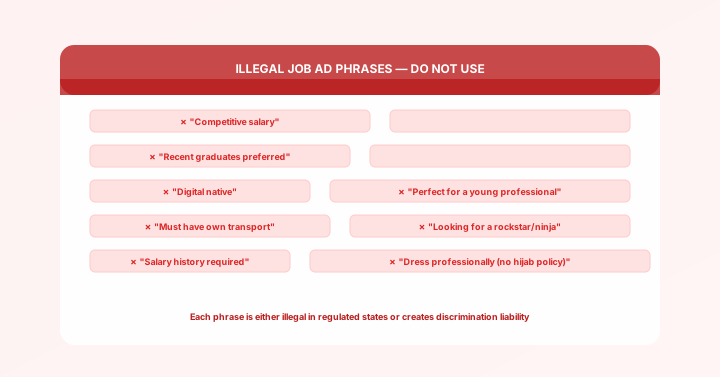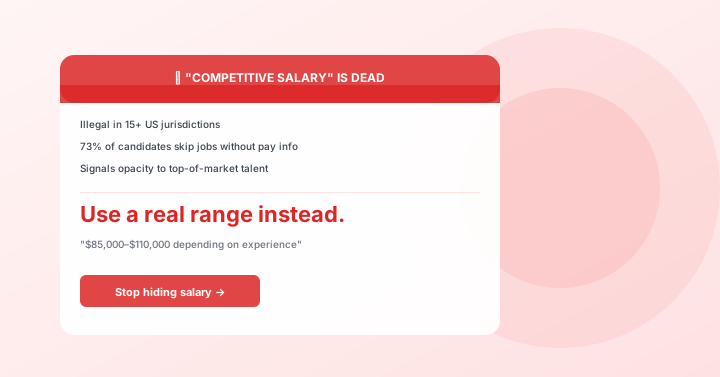
"Competitive salary" has been the lazy default of job ad copywriters for two decades. It was always useless — it conveys no information, it makes no commitment, and it answers no question that any candidate actually has. Now, in 15+ US states, Canada, and the entire EU, it is also illegal. It's time to retire it completely.
Why it was always a bad idea
Let's start before the legal argument. "Competitive salary" fails as a candidate communication tool for simple reasons:
- Every company believes its salary is competitive relative to something. The phrase carries zero information.
- Candidates in 2026 have Glassdoor, Levels.fyi, LinkedIn Salary Insights, and now millions of job postings with actual numbers. They know what "competitive" means in your market. If you're not confirming it, they assume you're below it.
- Studies on candidate behaviour consistently show that postings without salary information receive fewer qualified applications. Top candidates, who have options, skip listings that don't respect their time.
Now it is also illegal — in a lot of places
In California, New York, Colorado, Washington, Illinois, Minnesota, New Jersey, Maryland, Vermont, Connecticut, and Hawaii, a job posting that says "competitive salary" instead of an actual pay range is a violation of state law. The civil penalties are real:
- California: $100–$10,000 per violation
- Colorado: $500–$10,000 per violation
- New York City: up to $500,000 aggregate
- Minnesota: $500–$10,000 per violation
And under the EU Directive effective June 2026, "competitive salary" will be non-compliant across 27 countries covering 450 million people.
The talent cost nobody calculates
Beyond the legal penalties, there is an unquantified but real talent cost to vague compensation language. Candidates who are in demand — the ones you most want to attract — apply selectively. When they see "competitive salary," they read "the company is either below market, doesn't know its own comp, or doesn't want to tell me." All three interpretations send them elsewhere.
Some companies defend vague language by arguing it gives them flexibility in offers. This argument has two problems: first, posting a range does not prevent you from offering anywhere within that range. Second, the flexibility you gain is outweighed by the candidates you lose before you even have the chance to make an offer.
What to write instead
The replacement is simple:
That's it. Two sentences. Legal. Clear. Honest. And in every test we've seen, it converts more qualified candidates than any amount of "competitive" or "market-leading" language.
What about flexibility and individual negotiation?
Posting a range does not eliminate negotiation. It frames the negotiation. A candidate who knows the range is $85K–$115K can tell you where in that range they'd expect to land and why. You can tell them where in the range you're placing this offer and why. That's a better conversation for both sides — faster, more honest, and far less likely to result in a declined offer or a first-year attrition because the candidate felt underpaid.
What this means in practice
The shift to pay transparency is not just a legal requirement — it is a structural change in how employers and candidates interact. Research from the SHRM research on pay transparency and LinkedIn consistently shows that job postings with salary information receive significantly more applications, better-qualified candidates, and higher offer acceptance rates. The business case for transparency is as strong as the compliance case.
Employers who approach pay transparency strategically — not just by adding numbers to job postings but by building the compensation infrastructure that makes those numbers meaningful — consistently outperform those who treat it as a box to tick. The key elements of that infrastructure are: documented pay bands tied to roles and levels, external market benchmarking updated at least annually, clear criteria for where within a band an individual sits, and a regular pay equity audit to identify and remediate unexplained gaps.
The organisations getting the most value from pay transparency are those using it as the forcing function to fix compensation practices they knew were inconsistent but had not prioritised. The external disclosure requirement creates the internal discipline to get it right.
Further reading
To build a comprehensive understanding of pay transparency compliance and strategy, these resources cover the key areas:
- Pay transparency 101 — the fundamentals for HR teams
- Salary range best practices — how to write ranges that work across jurisdictions
- Job posting compliance audit — a step-by-step audit process
- US state law roundup — current requirements in every US state
- EU Pay Transparency Directive explained — the full EU framework
Start a free trial of RoleComply to automate pay transparency compliance across all your job postings.