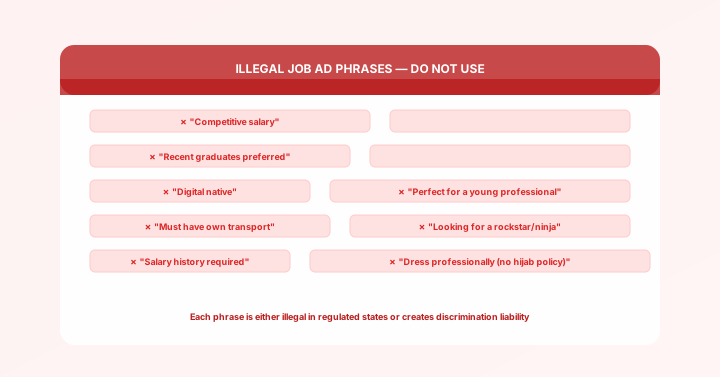
Job ad language is simultaneously one of the most visible and most overlooked compliance surfaces in HR. Every posting is a public document that creates legal exposure under at least three federal frameworks (EEOC, ADA, ADEA), applicable state pay transparency laws, and — for EU-accessible roles — the EU Pay Transparency Directive. Getting it right matters for both legal protection and talent acquisition: the same language patterns that create compliance risk also deter qualified candidates.
Salary and compensation language
DO: Include a specific salary range with minimum and maximum. "$85,000–$110,000 annually, depending on experience and qualifications" satisfies all active US pay transparency laws and the EU Directive. It's honest, it reduces candidate uncertainty, and LinkedIn research shows it increases application volume by 30–40% compared to omitting a range.
DON'T: Use "competitive salary," "market rate," "commensurate with experience," or "DOE" (depends on experience). These phrases are explicitly non-compliant in Colorado, Washington, Illinois, New Jersey, California, and NYC — and they signal to candidates that compensation may be below market. Even in jurisdictions that don't yet require disclosure, omitting a range reduces application volume. There's no upside to not including a range.
DON'T: Post ranges that aren't genuine. "$40,000–$200,000 for a mid-level role" is not a good-faith range — it's the legal risk of having a number without the compliance benefit of a genuine range. The NYC DCWP, Colorado CDLE, and California CRD have all signalled that excessively wide ranges attract scrutiny. Post what you'd actually pay.
Experience and qualification requirements
DO: Write specific, job-related qualification requirements. "5+ years of product management experience with direct ownership of a consumer-facing product roadmap" is specific, defensible, and informative. It tells candidates exactly what you're looking for and supports a merit-based selection process.
DON'T: Use education requirements that aren't genuinely necessary. "Bachelor's degree required" for a role where equivalent experience is acceptable creates disparate impact exposure under Title VII and EEOC guidance. Replace with "Bachelor's degree in [field] or equivalent combination of education and relevant work experience" — or better, describe the actual skills required without reference to degrees at all.
DON'T: Use maximum experience caps. "2–4 years of experience required" effectively excludes candidates over a certain age, creating ADEA exposure. If you want someone at a particular career stage, describe the scope of responsibility or complexity of work rather than years of experience: "Manages projects with moderate complexity and ambiguity, with growing ownership over time."
DON'T: Use "recent graduate" or "entry-level for new graduates." These phrases directly target a particular age group. "Entry-level" is fine. "Recent graduate preferred" creates ADEA risk.
Culture and personality language
DO: Describe observable outcomes and specific competencies. "Works effectively with product and engineering stakeholders to align on requirements" is informative and neutral. "Collaborates well in a cross-functional environment" is acceptable. These describe what success looks like without implying personality-type requirements.
DON'T: Use "rockstar," "ninja," "guru," or similar gig-culture terms. These terms have documented patterns of deterring women and older candidates. They're not legally prohibited, but they reduce the diversity of your candidate pool and signal a culture that may not reflect your actual workplace.
DON'T: Use "high energy," "fast-paced," "hustle culture," or "work hard, play hard." These phrases can screen out candidates with disabilities that affect energy levels (chronic illness, mental health conditions) and create ADA exposure. They also frequently deter candidates with family obligations. Describe the actual work environment: "Fast feedback cycles with sprint-based delivery" is more accurate and less legally fraught than "fast-paced environment."
DON'T: Use "culture fit" as a requirement or evaluation criterion. This term is legally vague and operationally meaningless — in practice, "culture fit" evaluations have been shown to encode bias based on race, age, and socioeconomic background. If you mean "shares our values around collaboration and transparency," say that specifically.
Physical and cognitive requirements
DO: Include only physical requirements that are genuinely essential to the role. "Must be able to stand for up to 8 hours for retail floor roles" is genuinely essential. "Must be able to lift up to 50 lbs" for a software engineer is not. Include an ADA accommodation statement alongside any physical requirements.
DON'T: Copy-paste physical requirements from templates without reviewing whether they apply to this specific role. This is the most common source of non-essential physical requirements in job postings. Every requirement should be assessed against the question: "Could a qualified person with a disability perform this role with reasonable accommodation if this requirement were absent?"
EEO and accommodation language
DO: Include a specific EEO statement and a specific accommodation request mechanism. "We are an equal opportunity employer" is a start, but it should be followed by enumeration of protected classes and a concrete process for requesting accommodation: "To request a reasonable accommodation, contact [email] prior to your scheduled interview."
DON'T: Treat the EEO statement as a checkmark without reviewing its completeness. Federal contractors need different EEO language than non-contractors. Non-contractors should at minimum list the protected classes. The standard paragraph that ends with "and any other basis protected by law" is acceptable but weaker than enumeration.
For the complete picture of what a fully compliant posting needs — including pay transparency requirements, EEOC elements, ADA language, and OFCCP requirements for contractors — see our pay transparency overview and EEOC compliance guide.