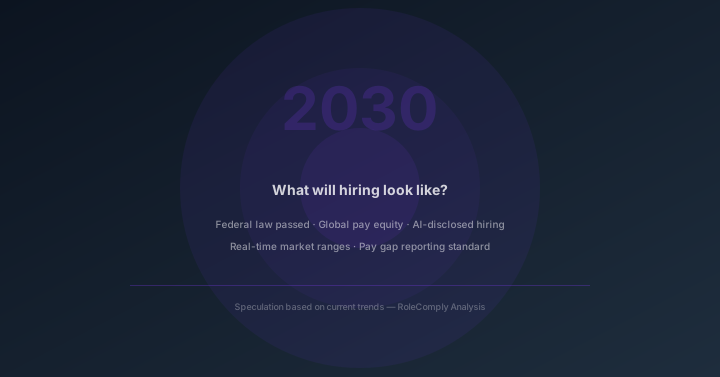
Pay transparency has gone from a niche policy debate to the defining compliance frontier of talent acquisition in under five years. The pace of change — 15 active US states, a mandatory EU directive, Canadian provinces moving in lockstep — makes 2030 a reasonable horizon to ask: what will hiring actually look like? Here is our informed speculation, based on current trends extrapolated forward.
- Federal law will have passed — or come very close
- Salary ranges will be on every job posting globally
- Real-time market compensation data will be publicly accessible
- Pay gap reporting will be standard practice for large employers
- AI will be both the problem and the solution
- Salary negotiation will look fundamentally different
- The organisations that thrive
Federal law will have passed — or come very close
By 2030, either a US federal pay transparency law will be in effect, or the state patchwork will have grown to such scale that the political will for federal standardisation becomes overwhelming. Businesses operating in 25+ regulated states have a strong incentive to prefer one federal rule. Our prediction: a federal posting requirement, modelled on Colorado's EPEWA, with a 15-employee threshold, will be enacted in the 2027–2029 window.
Salary ranges will be on every job posting globally
The EU Directive's June 2026 deadline makes salary range disclosure mandatory across 27 countries covering 450 million people. Canada's provinces are following. By 2030, most developed economies will have some form of pay transparency posting requirement. Candidates globally will have come to expect salary ranges in job ads — postings without them will signal an organisation that is either out of compliance or has something to hide.
Real-time market compensation data will be publicly accessible
With millions of salary ranges in job postings — publicly accessible, machine-readable, and accumulating since 2021 in the US — labour economists and commercial data providers will have the most comprehensive real-time compensation dataset in history. Levels.fyi, Glassdoor, and LinkedIn already build on this. By 2030, the concept of "confidential salary bands" will be largely meaningless: external market data will be accurate to within a few percentage points for most roles and industries.
Pay gap reporting will be standard practice for large employers
British Columbia already requires it for employers with 50+ employees. France and Germany have required it for years. The EU Directive mandates it across all member states. By 2030, publishing an annual gender pay gap report will be as standard for large employers as publishing a corporate social responsibility report — expected by investors, candidates, and regulators alike.
AI will be both the problem and the solution
AI hiring tools will be regulated in most major markets by 2030. Employers will be required to disclose when AI is used in hiring decisions, audit those systems for bias, and provide candidates with the ability to request human review. Simultaneously, AI-powered compliance tools will make real-time pay transparency monitoring standard — much as automated payroll tax compliance tools are standard today. The compliance burden won't disappear; it will be automated.
Salary negotiation will look fundamentally different
When every candidate knows the posted range, and when offer data is aggregated in real-time across platforms, the information asymmetry that has historically driven salary negotiation will largely disappear. Negotiation will shift from "discovering" the employer's ceiling to understanding where within a known range you should land based on your specific skills and the organisation's internal equity. See our full analysis of how pay transparency is changing salary negotiation.
The organisations that thrive
In 2030, the companies that attract the best candidates won't just be compliant — they'll have used transparency as a talent strategy. They'll have eliminated unexplained pay disparities, built trust through proactive disclosure, and positioned themselves as employers of choice in a market where candidates have more compensation data than ever before. The compliance question and the talent question are converging.