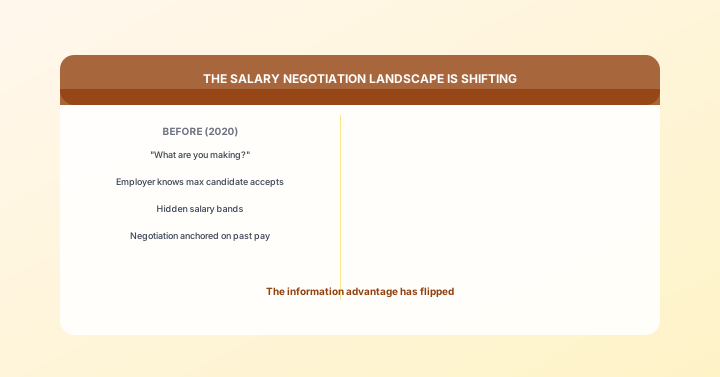
For decades, salary negotiation was a game played with fundamentally asymmetric information. Employers knew their salary bands; candidates typically didn't. Employers knew what the previous person in the role made; candidates didn't. This asymmetry consistently disadvantaged candidates — and consistently disadvantaged women and people of colour more than others. Pay transparency is systematically eliminating that asymmetry. What replaces it?
How the information advantage has shifted
Until 2021, a candidate negotiating a salary offer was largely working from external data — Glassdoor reviews, informal network conversations, their own prior salary. Employers controlled the information. That has changed significantly:
- Colorado's Equal Pay for Equal Work Act (2021) was the first law to require salary ranges in postings — creating a public database of employer compensation intent
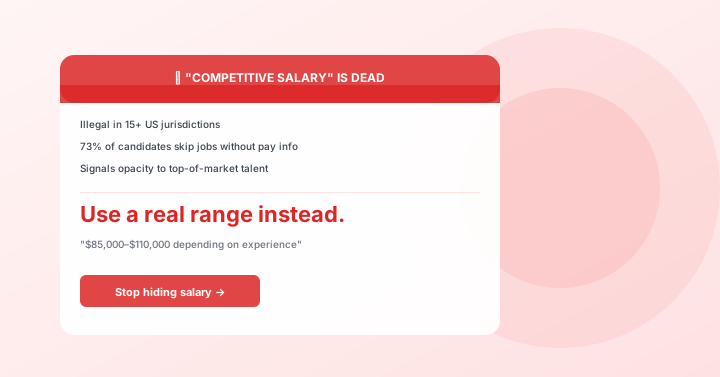
- By 2026, over 15 US states require ranges in postings; the EU mandates it for 27 countries
- Aggregators like Levels.fyi have built real-time, role-specific compensation benchmarks for tech roles with six-figure accuracy
- LinkedIn's Salary Insights feature now shows median compensation for specific job titles in specific markets, sourced partially from posted ranges
A candidate today can walk into a salary conversation knowing the company's posted range, the market median for the role, and — if they've done their homework — what similar candidates at similar companies have been offered. The information asymmetry has not disappeared, but it has substantially narrowed.
What negotiation looks like when ranges are disclosed
The conversation changes shape when both parties know the range. Instead of:
It becomes:
The second conversation is more honest, more efficient, and — research consistently shows — results in better outcomes for both parties.
What kind of negotiation is disappearing
The specific negotiation tactics that rely on information asymmetry are becoming obsolete:
- Anchoring on prior salary: Prohibited in most regulated states; and with market data available, candidates increasingly refuse to disclose prior pay
- "We can do $X — is that enough to get you to accept?" — Undercutting below a known range is now both legally risky and obviously visible to candidates
- Bait-and-switch offers: Advertising a range in a posting and then offering below the minimum is a compliance violation in Colorado and increasingly scrutinised elsewhere
What negotiation is evolving into
Rather than disappearing, salary negotiation is shifting to new terrain:
- Where within the range: Both parties have a shared interest in arriving at the right placement within the range based on skills, experience, and internal equity
- Total compensation: With base salary increasingly transparent, negotiation is shifting to equity, bonus structure, flexible work arrangements, and professional development investment
- Range authenticity: Savvy candidates now ask whether the range is "real" — do offers typically land across the range or cluster at the bottom? This is a legitimate question, and companies that answer honestly build trust
Implications for HR and TA teams
The shift toward transparent negotiation requires new skills from TA teams. Recruiters need to be comfortable defending where in the range an offer sits — and that defence needs to be based on skills and internal equity, not on the candidate's prior pay or negotiating confidence. Build this into your recruiter training. The companies that do this well will close more candidates faster and lose fewer to counter-offers.
What this means in practice
The shift to pay transparency is not just a legal requirement — it is a structural change in how employers and candidates interact. Research from the SHRM and LinkedIn consistently shows that job postings with salary information receive significantly more applications, better-qualified candidates, and higher offer acceptance rates. The business case for transparency is as strong as the compliance case.
Employers who approach pay transparency strategically — not just by adding numbers to job postings but by building the compensation infrastructure that makes those numbers meaningful — consistently outperform those who treat it as a box to tick. The key elements of that infrastructure are: documented pay bands tied to roles and levels, external market benchmarking updated at least annually, clear criteria for where within a band an individual sits, and a regular pay equity audit to identify and remediate unexplained gaps.
The organisations getting the most value from pay transparency are those using it as the forcing function to fix compensation practices they knew were inconsistent but had not prioritised. The external disclosure requirement creates the internal discipline to get it right.
Further reading
To build a comprehensive understanding of pay transparency compliance and strategy, these resources cover the key areas:
- Pay transparency 101 — the fundamentals for HR teams
- Salary range best practices — how to write ranges that work across jurisdictions
- Job posting compliance audit — a step-by-step audit process
- US state law roundup — current requirements in every US state
- EU Pay Transparency Directive explained — the full EU framework
Start a free trial of RoleComply to automate pay transparency compliance across all your job postings.