A pay equity audit is a systematic analysis of your organisation's compensation data to determine whether employees performing comparable work are paid equitably, regardless of gender, race, ethnicity, or other protected characteristics. As pay transparency laws proliferate and require employers to disclose salary ranges, the gap between posted ranges and actual pay — or between pay for employees with comparable roles — is increasingly visible to employees, candidates, and regulators alike.
Why pay equity audits matter now
Pay transparency law creates a direct link between pay equity and job posting compliance. When you post a salary range of $90,000–$115,000 for a role, candidates can see it. When those candidates become employees, they can compare their compensation against posted ranges for similar roles at other employers. And under the EU Pay Transparency Directive and several US state laws, employees have the right to request information about pay for comparable roles within the organisation.
Employers with significant unexplained pay gaps are not just exposed to regulatory action — they're exposed to employee relations issues and talent loss as those gaps become visible through transparency requirements. The EU Directive's 5% trigger (an unexplained gap of 5% or more requires a mandatory joint pay assessment with employee representatives) creates a direct enforcement mechanism for pay inequity.
The controlled vs uncontrolled gap distinction
Before diving into the five-step process, it's worth understanding the two types of pay gap analysis — because confusing them is one of the most common pay equity mistakes.
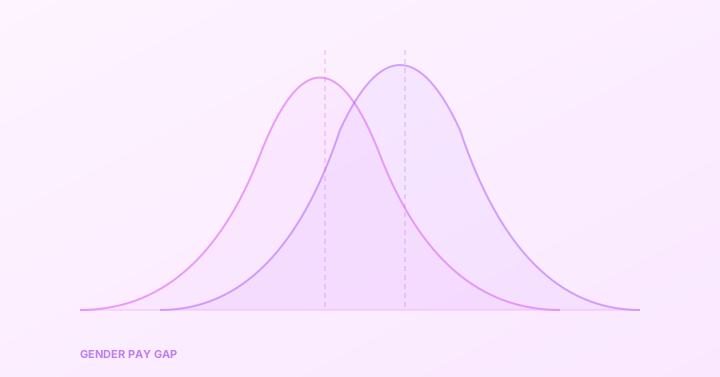
The uncontrolled (raw) gap compares average pay across groups without controlling for any other factors. If women in your organisation earn 82% of what men earn on average, the uncontrolled gap is 18%. This is what national gender pay gap statistics typically measure — it reflects differences in role distribution, seniority distribution, and all other factors as well as any unexplained discrimination.
The controlled (adjusted) gap compares pay for employees in comparable roles, at comparable levels, with comparable tenure and performance, isolating the unexplained difference attributable to gender, race, or other protected characteristics. A controlled gap of 3% in a role where women are paid 3% less than comparable men — after controlling for all legitimate factors — is a more actionable and legally significant finding.
The EU Directive requires reporting on both. Most pay equity litigation focuses on the controlled gap. Both matter for different reasons.
The five-step pay equity audit process
Step 1: Define comparator groups
Group employees into comparator sets — people performing the same or substantially similar work. This is more nuanced than grouping by job title. Two employees with the same title may perform materially different work; two employees with different titles may perform essentially the same work. Key factors for comparator group construction: core duties and responsibilities, required skills and qualifications, responsibility level (including supervisory scope), and working conditions. Document your methodology — regulators will ask how you defined comparators if an audit results in scrutiny.
Step 2: Gather comprehensive compensation data
Include all forms of compensation: base salary, variable cash (bonus, commission), equity (value at grant, or annual vesting value for comparability), and any material allowances or benefits with cash value. Many pay equity analyses focus only on base salary and miss significant gaps in variable compensation and equity distribution. The EU Directive specifically requires analysis by individual pay component, not just total compensation.
Step 3: Run the statistical analysis
For each comparator group, calculate pay by protected characteristic category and test for statistical significance. Gaps that aren't statistically significant (due to small sample sizes) require qualitative review rather than statistical conclusion. For comparator groups with fewer than five employees in any category, aggregate to a larger grouping for analysis.
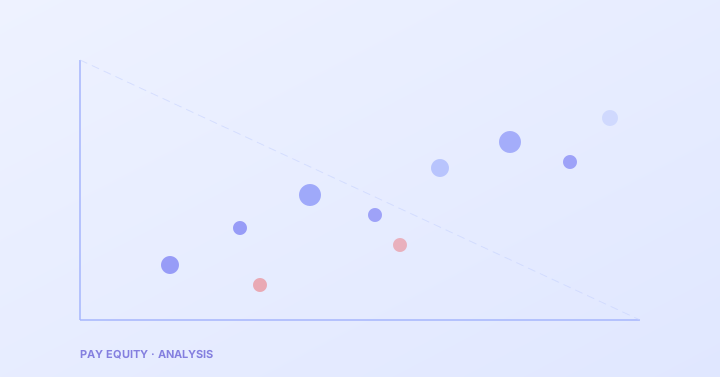
Run both uncontrolled and controlled analyses. The controlled analysis should model compensation as a function of legitimate pay factors (level, tenure, performance rating, location) and test the residual variance attributable to protected characteristics. This requires regression analysis — most HR analytics platforms have this capability, or engage an external consultant for the first cycle.
Step 4: Investigate outliers and document rationale
For each identified gap that passes the significance threshold, investigate the root cause. Legitimate explanations include: documented performance differences, market data supporting different rates for specific skills, geographic pay differentials, and grandfathered compensation from acquisitions. Document each legitimate explanation with supporting evidence — the documentation protects against regulatory claims and provides the basis for a defensible position.
Illegitimate explanations — "that's what they negotiated," "historical reasons," "they were already earning that" — are not valid justifications under the EU Directive and are increasingly not accepted by US enforcement agencies either.
Step 5: Remediate and track
Develop a phased remediation plan for unexplained gaps. Most organisations cannot afford to close all gaps in a single budget cycle — a credible plan with specific timelines, budget allocation, and quarterly progress tracking satisfies regulators far better than no plan. Document the plan, get leadership sign-off, and track progress formally.
How pay equity connects to job posting compliance
The pay equity audit process and job posting compliance are connected in a practical way: you cannot post a good-faith salary range without knowing what you're actually paying employees in that role. If your pay equity audit reveals that employees in a role are earning across a wide range — say $80K–$140K for a "Senior Software Engineer" — the underlying compensation architecture needs to be clarified before you can post a compliant, defensible range for new hires.
This is why the sequence matters: pay equity audit → salary band documentation → compliant job posting. Skipping the audit and going straight to posting ranges may mean posting ranges that don't reflect your actual compensation reality — which creates its own compliance exposure and undermines the audit's intent. See our salary range best practices guide for how to translate pay equity work into compliant posting language.