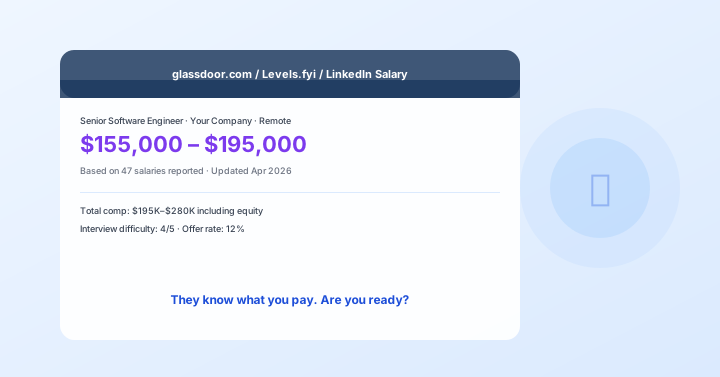
Your top engineering candidate didn't come into the first interview blind. She spent fifteen minutes on Glassdoor, cross-referenced with Levels.fyi, checked LinkedIn Salary Insights, and read through a Blind thread from employees at your company. She knows your salary bands better than half your hiring managers. The question is whether your job posting reflects that — or whether you're still pretending pay is a secret.
The salary transparency the internet already provides
Across four primary platforms, candidates have access to more compensation data than most companies share internally:
- Glassdoor: Self-reported salaries by role, level, and location. Typically has good data for companies with 50+ employees. Updated continuously by current and former employees.
- Levels.fyi: Extremely detailed tech industry compensation data including base, bonus, equity, and signing bonus. Covers hundreds of thousands of roles at major tech companies with remarkable accuracy.
- LinkedIn Salary Insights: Aggregated compensation data tied to verified job history, cross-referenced across millions of profiles. Particularly reliable for professional and managerial roles.
- Blind: Anonymous employee forum where compensation is discussed in detail. Often contains specific numbers from named employers that would never appear in official sources.
For any company with more than a few hundred employees, this data is comprehensive and surprisingly accurate. Your candidates are using it before every first conversation.
What this means for your talent strategy
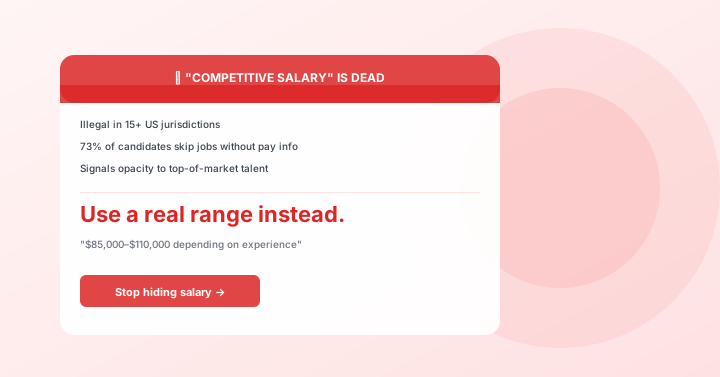
If candidates already know your salary ranges — or close to them — then refusing to include them in your job ads doesn't protect information. It just signals opacity. The candidate who knows from Levels.fyi that your senior engineers earn $180K–$220K sees your "competitive salary" posting and draws one of three conclusions: you don't know your own market rates, you know them and don't want to be held to them, or your ranges are below market. None of these conclusions helps you hire.
The candidate who does not do this research — who walks in without checking external sources — is more likely to be early-career, less in-demand, or less sophisticated about compensation. Is that the candidate you want?
The negotiation dynamic has changed
Traditional salary negotiation assumed information asymmetry — the employer knew the range, the candidate didn't, and the negotiation was about closing that gap. That asymmetry is largely gone for professional roles. Today's negotiation starts from a shared baseline of market data, and candidates who feel they were low-balled relative to market data don't just decline the offer — they leave reviews, post on Blind, and tell their professional network.
The companies that are thriving at hiring understand this shift. They lead with salary information because it is efficient, honest, and builds candidate trust. They treat compensation transparency as a recruiting advantage rather than a vulnerability.
The counter-intuitive truth about pay transparency
Many HR leaders fear that publishing salary ranges will lead to chaos — every employee demanding the top of their band, every candidate anchoring to the maximum. The research does not support this. Harvard Business Review analysis of organisations that implemented voluntary pay transparency found that within 18 months, pay equity improved, employee satisfaction around compensation increased, and turnover declined. The most consistent finding: transparency reduced the perception that pay was unfair, even when the actual pay numbers did not change.
You cannot un-ring the bell of internet salary data. You can decide whether to lead with transparency or be perceived as lagging it.
Practical recommendation
Before your next posting goes live, spend five minutes on Glassdoor and LinkedIn Salary Insights looking at what your candidates already see. Compare it to your posted range — or to your absence of a posted range. If the gap between what's publicly known and what you're communicating is large, you have a transparency problem that posting a real range will fix almost immediately.