Fifteen US jurisdictions have active pay transparency laws. Each has its own employer threshold, disclosure requirements, and penalty structure. This cheat sheet gives recruiters and HR teams a fast, scannable reference for every active law — what you must include, for which employers, and what failure costs.
How to use this guide
For each job posting, identify the applicable jurisdiction(s) — remembering that remote roles may trigger multiple states simultaneously. Then apply the strictest requirement. If you want one template that works everywhere: include salary range (min and max), benefits description, and no salary history requests. That covers every active US law and the EU Directive.
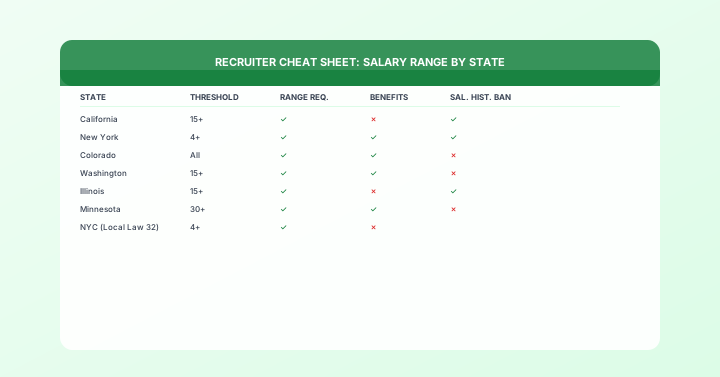
Active US state requirements at a glance
| State / City | Effective | Threshold | Range required | Benefits | History ban | Max fine |
|---|---|---|---|---|---|---|
| California (SB 1162) | Jan 2023 | 15+ employees | Yes | No | Yes | $10,000/violation |
| NYC (Local Law 32) | Nov 2022 | 4+ employees | Yes | No | Yes | $500,000 aggregate |
| New York State | Sep 2023 | 4+ employees | Yes | Yes | Yes | $3,000/violation |
| Colorado (EPEWA) | Jan 2021 | All employers | Yes | Yes | No | $10,000/violation |
| Washington State | Jan 2023 | 15+ employees | Yes | Yes | No | $1,000+ per violation |
| Illinois (SB 3129) | Jan 2025 | 15+ employees | Yes | No | Yes | $10,000/violation |
| New Jersey | Jun 2024 | All employers | Yes | No | Yes | Varies |
| Minnesota (SF 3071) | Jan 2025 | 30+ employees | Yes | Yes | No | $10,000/violation |
| Hawaii (HB 1057) | Jan 2024 | 50+ employees | Yes | No | Yes | $10,000/violation |
| Vermont (Act 155) | Jul 2025 | 5+ employees | Yes | No | No | $10,000/violation |
| Connecticut | Oct 2021 | All employers | Yes | Yes | Yes | $5,000/violation |
| Maryland (HB 649) | Oct 2024 | 15+ employees | Yes | Yes | No | $1,200/violation |
| Massachusetts (SB 1558) | 2026 | 25+ employees | Yes | No | Yes | $25,000/violation |
Canada quick reference
| Province | Law | Status | Key requirement |
|---|---|---|---|
| British Columbia | Pay Transparency Act | Active (Nov 2023) | Range in all postings + annual report |
| Ontario | Working for Workers Four | Active (2024) | Range + AI disclosure (25+ employees) |
| Prince Edward Island | Pay Transparency Act | Active | Expected pay in all postings |
| Federal (regulated sectors) | Pay Equity Act | Active (2021) | Pay equity plans required |
EU quick reference
All 27 EU member states must transpose the EU Pay Transparency Directive (2023/970/EU) by June 7, 2026. Requirements include: salary range in all job postings, salary history ban, and annual pay gap reporting for employers with 100+ employees. Germany, France, Ireland, and the Netherlands already have national frameworks active. See individual country guides for specifics.
The single-template approach for remote roles
For remote roles posted nationally (US), apply this template to satisfy all active state laws simultaneously:
- Salary range: state minimum and maximum (e.g. "$85,000–$110,000 per year")
- Benefits: brief list of material benefits (e.g. "health, dental, vision, 401k with 4% match, 20 days PTO")
- Do not ask about salary history anywhere in the application or screening process
This covers Colorado (the strictest US state requirement), which is a superset of every other active requirement.
What this means in practice
The shift to pay transparency is not just a legal requirement — it is a structural change in how employers and candidates interact. Research from the US DOL Wage and Hour Division and LinkedIn consistently shows that job postings with salary information receive significantly more applications, better-qualified candidates, and higher offer acceptance rates. The business case for transparency is as strong as the compliance case.
Employers who approach pay transparency strategically — not just by adding numbers to job postings but by building the compensation infrastructure that makes those numbers meaningful — consistently outperform those who treat it as a box to tick. The key elements of that infrastructure are: documented pay bands tied to roles and levels, external market benchmarking updated at least annually, clear criteria for where within a band an individual sits, and a regular pay equity audit to identify and remediate unexplained gaps.
The organisations getting the most value from pay transparency are those using it as the forcing function to fix compensation practices they knew were inconsistent but had not prioritised. The external disclosure requirement creates the internal discipline to get it right.
Further reading
To build a comprehensive understanding of pay transparency compliance and strategy, these resources cover the key areas:
- Pay transparency 101 — the fundamentals for HR teams
- Salary range best practices — how to write ranges that work across jurisdictions
- Job posting compliance audit — a step-by-step audit process
- US state law roundup — current requirements in every US state
- EU Pay Transparency Directive explained — the full EU framework
Start a free trial of RoleComply to automate pay transparency compliance across all your job postings.