Remote-first companies face the most complex pay transparency compliance environment of any employer type. With no single physical location to anchor job postings, every role is potentially subject to the laws of every state and country where a candidate could work. This guide explains how to navigate that complexity without building a compliance team to match.
The core challenge: no location means all locations
Traditional pay transparency compliance was relatively simple: if your company has offices in California and New York, comply with California and New York law. For remote-first companies, the geography is everywhere a candidate could plausibly work — which, for many positions, is anywhere in the United States, Canada, or the EU.
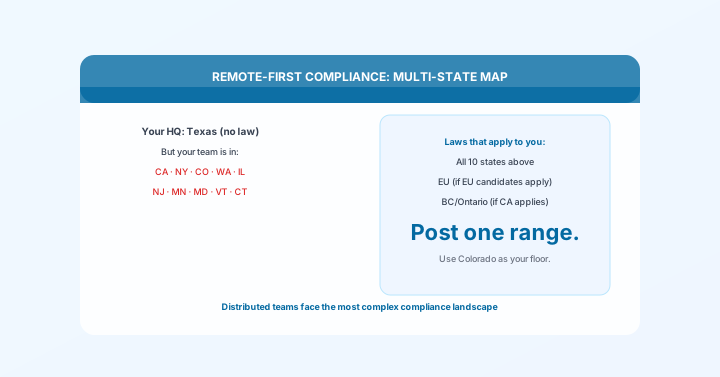
This creates a coverage question: when you post a "fully remote" role, which laws apply? The answer from every regulator that has addressed this question: the law of the state or country where the candidate will be performing the work. For remote roles where candidates can be anywhere, you are effectively subject to the requirements of every jurisdiction where you're likely to receive applications.
The practical solution: Colorado as your floor
For US remote postings, apply Colorado's requirements as your minimum standard. Colorado's Equal Pay for Equal Work Act has the broadest scope (1+ employees), requires the most complete disclosure (salary range + benefits description + general job description detail), and has been in force the longest with the most developed compliance guidance. If your posting satisfies Colorado, it satisfies every other active US state.
See the full guide to one-range-fits-all strategy for the methodology.
International remote teams
For remote-first companies that hire internationally, the complexity compounds:
- EU candidates: The EU Pay Transparency Directive applies to postings accessible to EU-based candidates from June 2026. If you hire EU engineers remotely, your postings need to include a salary range that satisfies Directive requirements.
- Canadian candidates: British Columbia, Ontario, and PEI have active posting requirements. If you hire Canadian remote workers, include a salary range that covers these requirements.
- UK candidates: The UK does not have a pay transparency posting requirement (post-Brexit). However, UK employers with 250+ employees must report gender pay gaps.
Jurisdiction mapping for remote-first companies
Build a simple jurisdiction matrix that maps each of your typical candidate locations to the applicable posting requirements. For a US-remote company that also hires in Canada and Europe, the matrix might look like:
| Where candidates are based | Applicable law | Key requirement |
|---|---|---|
| Any US state (all-remote posting) | Colorado EPEWA (floor) | Salary range + benefits + job description |
| California specifically | SB 1162 + Colorado floor | Salary range (SB 1162 is satisfied by CO floor) |
| New York City | Local Law 32 + NY State | Salary range + benefits (both apply) |
| British Columbia, Canada | BC Pay Transparency Act | Pay range in posting |
| Ontario, Canada | Working for Workers Four | Range + AI disclosure |
| EU member states | EU Directive (Jun 2026) | Salary range |
Handling the benefits description
Colorado, New York State, Minnesota, Illinois, and Washington require a description of benefits in job postings. For remote-first companies with geographically distributed teams, benefits often vary by country. The solution: post the benefits available to the relevant candidate pool. For a US-remote role, list US benefits. If you hire both US and EU candidates for the same role, consider noting that benefits vary by location and directing candidates to a benefits overview page.
Your careers page as a compliance anchor
Remote-first companies typically have a single careers page that surfaces to candidates globally. This creates a compliance advantage: one well-maintained posting library that meets the most demanding applicable requirements satisfies all jurisdictions simultaneously. The challenge is maintaining consistency — ensuring that the same role posted on LinkedIn, Indeed, your ATS, and your careers page all show the same salary range.
Tooling for remote-first compliance
Manual compliance management doesn't scale for remote-first companies with distributed hiring across dozens of states and countries. The combination that works: structured job description templates with salary range fields that are required (not optional), automated scanning of your careers page to catch missing or inconsistent ranges, and a jurisdiction matrix that's updated as new laws take effect. RoleComply handles the last two; your HRIS or ATS can handle the first.