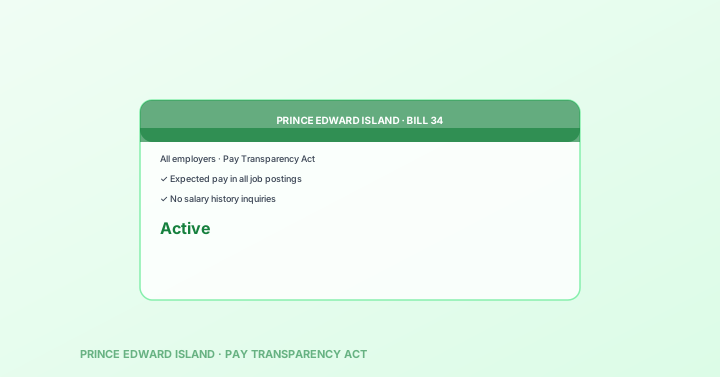
Prince Edward Island enacted the Pay Transparency Act (Bill 34) in 2022, making it one of the earlier Canadian provinces to require pay disclosure in job advertisements. PEI's law applies to all employers that post publicly accessible job opportunities on the island.
Who does PEI's Pay Transparency Act apply to?
The Act applies to all employers in PEI that publicly post job opportunities — there is no minimum employee count. This makes it one of the broadest-scope pay transparency laws in Canada.
What must job postings include?
- The expected pay or pay range for the position — employers must state what they genuinely expect to pay
- A fixed pay rate is acceptable if the compensation is set (e.g. a government-grade role)
Salary history prohibition
PEI's Act also prohibits employers from seeking, using, or requiring salary history from applicants as a condition of being considered for a position. Employers may not use prior pay to set compensation — the role's own pay scale must drive the offer.
Employer checklist
- ✓ Include expected pay or pay range in all PEI job postings
- ✓ Remove salary history questions from applications and interviews
- ✓ Applies to all employers regardless of size
How RoleComply helps
RoleComply checks postings for PEI-applicable roles against the pay range requirement. Given PEI's all-employer scope, even small companies recruiting on the island need to include pay ranges in their postings.
What employers in Prince Edward Island must do
The PEI Employment Standards is the authoritative source for compliance requirements in this jurisdiction. Regardless of the specific status of local legislation, employers in Prince Edward Island should treat pay range disclosure as a baseline requirement today — the direction of travel is clear, and proactive employers are already ahead.
Audit all job postings. Pull every active role from your careers page, LinkedIn, Indeed, and any job boards or agencies posting on your behalf. Verify each posting includes a wage or salary range. Where ranges are missing, add them. Where ranges exist but are placeholder-wide, replace them with real, defensible figures connected to your compensation structure.
Build formal pay bands. The range you post must reflect what you would actually pay. This requires a compensation framework: roles mapped to levels, benchmarked externally, with documented criteria for where within a band an individual employee sits. Without this, you cannot post credible ranges consistently.
Remove salary history questions. Pay transparency legislation consistently prohibits asking candidates about their current or previous salary. Review your application forms, recruiter screening scripts, and any pre-employment questionnaires to ensure salary history questions have been removed entirely.
The business case for going further
Employers who post salary ranges report better application quality, faster time-to-fill, and stronger employer brand scores. Candidates self-select based on realistic expectations, offer acceptance rates improve, and internal pay equity conversations become easier when compensation is documented and transparent. The compliance obligation is the floor — the strategic opportunity is considerably higher.
Read our pay transparency fundamentals guide for the full picture, or see our remote work compliance guide for managing obligations across multiple Canadian provinces.
Building a future-proof compliance process
Pay transparency is not a one-time project. Laws change, new jurisdictions add requirements, and regulators update their enforcement guidance. The employers who stay compliant without constant firefighting are those who build transparency into their standard recruiting process — not as an add-on, but as a default.
The most effective approach is to treat salary range disclosure as mandatory for every posting, everywhere, regardless of whether the specific jurisdiction currently requires it. This eliminates the need to maintain a compliance matrix by location and ensures you are never caught out by a new law taking effect. It also signals to candidates that transparency is a company value, not a legal minimum.
Pair this with a quarterly posting audit: pull every active job from every platform where you advertise, check for compliance issues, and fix them before candidates or regulators notice. Tools like RoleComply automate this scan, flagging missing ranges, banned phrases, and jurisdiction-specific violations in real time before any posting goes live.
Finally, invest in recruiter training. The people writing and publishing job postings need to understand both what is required today and why the broader shift to transparency is happening. When recruiters understand the strategic rationale — not just the compliance requirement — they become advocates for the process rather than obstacles to it.
For more, read our pay transparency fundamentals guide, explore the job posting compliance audit checklist, or start a free trial of RoleComply to see automated compliance checking on your own job postings.