Despite the rapid spread of pay transparency laws across the US, Canada, and Europe, a consistent set of myths continues to drive compliance avoidance and half-measures. These myths are costly — they lead companies to delay, cut corners, or implement policies that technically comply but create no real benefit. Here are the five most persistent, and why they're wrong.
- Myth 1: "Posting salary ranges will cause salary inflation"
- Myth 2: "We only need to comply in states where we have offices"
- Myth 3: "Showing our salary ranges exposes our compensation structure to competitors"
- Myth 4: "Pay transparency will cause our best performers to leave when they see what others make"
- Myth 5: "We're too small to need to comply"
Myth 1: "Posting salary ranges will cause salary inflation"
The fear: If we post our range publicly, current employees will see it and demand more. If our range is at market, candidates will negotiate to the top. We'll end up paying everyone more.
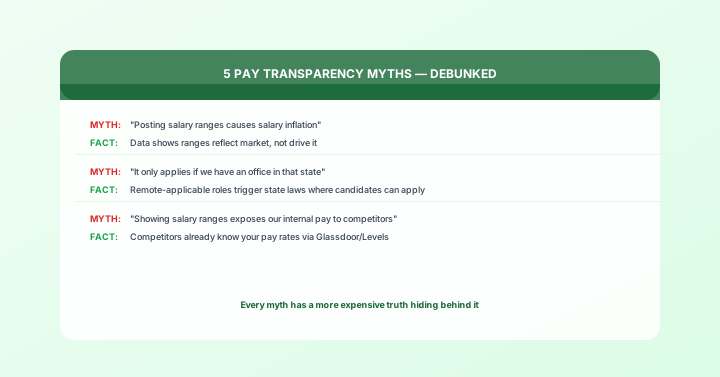
The reality: Research from Colorado, which has had pay transparency since 2021, does not support this claim. A 2023 study of Colorado job postings found no evidence of systematic salary inflation attributable to the posting requirement. What did change: ranges became more accurate reflections of actual hiring intent, compressing artificially wide aspirational bands.
The deeper issue: if your current employees would demand more if they saw your posted range, that's a pay equity problem you already have — transparency just reveals it. Companies that discover they're paying below their posted range for existing employees have an internal equity problem that predates any transparency law.
Myth 2: "We only need to comply in states where we have offices"
The fear: Our HQ is in Florida, which has no pay transparency law. We don't need to worry about New York or California requirements.
The reality: The laws in regulated states apply based on where the candidate will be working, not where the company is headquartered. For remote or hybrid roles, if a candidate in New York, California, or Colorado could realistically apply, those states' laws apply to that posting — regardless of where your office is.
This is the most common compliance misunderstanding we see. Florida-headquartered companies with remote workforces are in scope for California, New York, Colorado, and every other state where their candidates could be based.
Myth 3: "Showing our salary ranges exposes our compensation structure to competitors"
The fear: Our compensation is a competitive advantage. If we post ranges, competitors will undercut us or poach our employees.
The reality: Your competitors already know your approximate compensation. Glassdoor, Levels.fyi, LinkedIn Salary Insights, Blind, and Paysa have been aggregating employee-reported compensation data for years. Anyone who wants to know what you pay for a senior engineer can find out in about 90 seconds. Posting a range in a job ad reveals almost nothing that isn't already visible.
Myth 4: "Pay transparency will cause our best performers to leave when they see what others make"
The fear: If employees can see compensation data — either through posted ranges or through peer conversations — high performers who discover they're underpaid relative to colleagues will walk.
The reality: This is only a problem if you actually are underpaying your high performers. If that's the case, the risk isn't transparency — it's the underlying pay inequity. High performers who are paid fairly relative to their contribution and the market are not materially more likely to leave when they have more information about compensation.
What does cause high performer attrition is discovering they've been underpaid for years and that the information was deliberately hidden from them. Transparency is not the risk — inequity is.
Myth 5: "We're too small to need to comply"
The fear: We're a 25-person startup. Pay transparency laws are for big companies with huge HR teams.
The reality: Connecticut's law applies to all employers. Vermont's applies to employers with 5 or more employees. Colorado's applies to employers with 1 or more employees. Many state laws use lower thresholds than you might expect, and the EU Directive has no minimum employer size for posting requirements.
Startups that hire early with vague compensation signals often discover compounding pay equity problems within 2–3 years: employee A was hired at $95K; employee B, hired 18 months later for the same role in a different market, is at $85K; employee C negotiated hard and is at $110K. Without a structured approach from the beginning, pay equity problems grow with headcount.