New Jersey's pay transparency law (S2310), effective June 1, 2025, has rapidly become one of the most actively enforced pay transparency statutes in the United States. The New Jersey Department of Labor and Workforce Development (NJDOL) began formal enforcement in February 2026, issuing Notices of Violation to employers with non-compliant postings on major job boards. With one of the lowest employee thresholds of any active state — just 10 employees — New Jersey's law affects a broad population of employers who may not yet realise they're covered.
Who S2310 covers
The 10-employee threshold is counted globally, not just among New Jersey employees. A company with nine US employees and one international employee has ten total and is covered by S2310 if it posts any role accessible to New Jersey residents.
Coverage extends to: direct employers posting to their own careers pages or job boards, staffing agencies and recruiting firms posting on behalf of covered employers, and third-party job boards posting NJ-accessible roles on behalf of covered employers. The NJDOL's enforcement guidance explicitly states that agencies are responsible for compliance — not just the client employer.
Remote roles are broadly covered. The NJDOL's position, consistent with other state agencies, is that if a New Jersey resident could reasonably apply for and perform a remote role, the role is "accessible to New Jersey residents" and S2310 applies.
What must be disclosed
S2310 requires disclosure of the minimum and maximum base salary or hourly rate for the position. Unlike Colorado and Washington, New Jersey does not yet require benefits or bonus disclosure. However, the NJDOL's enforcement guidance recommends that employers include benefits information as a best practice, noting that the legislature may expand requirements in future sessions.
The good faith standard applies: the disclosed range must reflect what the employer genuinely intends to pay. The NJDOL has issued guidance similar to the NYC DCWP's position — ranges that are excessively wide suggest bad faith and may not satisfy the law's requirements even if a number is technically present.
Internal postings and promotions
S2310 includes a requirement for internal postings that's similar to Illinois's SB 3129: promotional opportunities and transfer opportunities posted to existing employees must also include pay range information. This requirement frequently catches employers who are focused on external compliance but haven't updated their internal career development systems.
Enforcement: what's happening in 2026
The NJDOL's enforcement approach is more aggressive than most other states. Rather than waiting for complaints, the department is conducting proactive audits of major job boards — pulling New Jersey-tagged postings and checking for missing salary ranges. Key enforcement observations from the first months of active enforcement:
- The NJDOL is focusing initial enforcement on large employers with high-volume postings on LinkedIn and Indeed
- Remote roles are a specific focus — many employers failed to treat "Remote — NJ" or "Remote — Northeast" postings as S2310-covered
- Agencies posting on behalf of client employers have received enforcement letters in addition to or instead of the client employer
- First-time violations for employers who self-correct quickly are receiving administrative penalties in the $1,000–$3,000 range; employers who fail to respond receive the full $5,000 per-posting penalty
How to audit your NJ exposure
If you haven't yet audited your New Jersey compliance, the process is straightforward but time-sensitive given active enforcement:
- Pull all active job postings from your careers page and major job boards
- Flag all postings tagged as New Jersey, New York metro, Northeast, or "Remote — US"
- Check each for: salary range present (minimum and maximum), range reflects genuine compensation intent
- Verify that your ATS is syndicating salary data correctly — many platforms strip salary information when syndicating to job boards
- Check with your recruiting agencies that they're including salary ranges on all NJ-accessible postings
- Review internal promotion and transfer postings for pay range inclusion
For national employers, the efficient approach is to bring all postings into Colorado/Washington compliance — which automatically satisfies New Jersey and every other active state. See our salary range best practices guide for a universal template.
How NJ interacts with the NYC metro compliance landscape
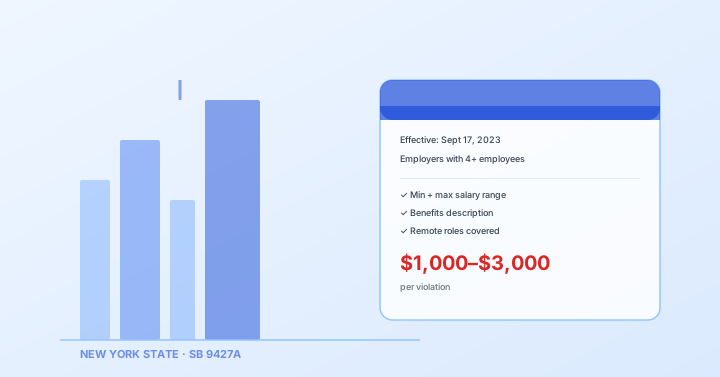
The New Jersey-New York City metro area creates layered compliance obligations for employers in the region. Most roles in the NYC metropolitan area are accessible to both NYC residents (covered by Local Law 32) and New Jersey residents (covered by S2310). The requirements are broadly similar — both require a minimum/maximum salary range — but have different employer thresholds (4 employees for NYC, 10 for NJ) and different fine structures. Employers compliant with Local Law 32 are generally compliant with S2310 as well, provided they're correctly treating NJ-accessible remote roles as covered. See our NYC Local Law 32 guide for a full comparison.