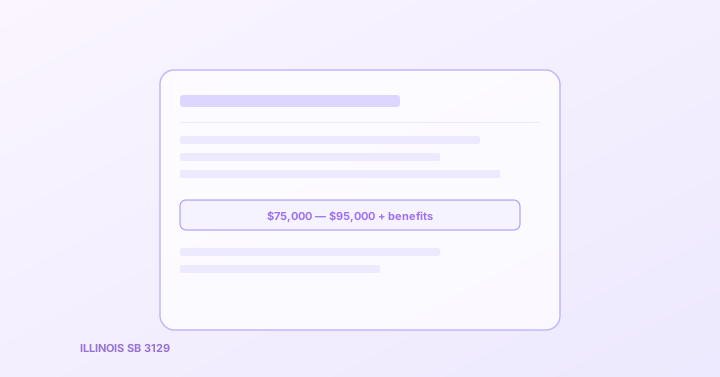
Illinois SB 3129, signed into law in August 2023 and effective January 1, 2025, requires pay scale and benefits information in all job postings for employers with 15 or more employees. The Illinois Department of Labor (IDOL) published a comprehensive FAQ in January 2026 that resolved several key questions about the law's scope and requirements — and expanded the population of affected employers significantly.
Who is covered
The 15-employee threshold counts all employees globally, not just employees in Illinois. A company with eight US employees and seven international employees has 15 total and is covered by SB 3129 if it posts any roles accessible to Illinois residents.
The January 2026 IDOL FAQ settled the remote work question definitively: if a position is described as remote or location-flexible, it is covered by SB 3129 regardless of where the employer is incorporated or based. A Seattle-based software company with 15 employees posting a "Remote — US" engineering role must comply with Illinois's requirements because an Illinois resident could reasonably apply.
Third-party recruiters and staffing agencies posting roles on behalf of covered employers are also subject to the law. If your recruiting agency posts roles on your behalf, they need to include pay range information — and you bear responsibility for ensuring their compliance.
What must be disclosed
SB 3129 requires disclosure of the "pay scale and benefits for the position." Unlike Colorado and Washington, Illinois does not require a specific format. The disclosure can take several forms:
- A salary range with minimum and maximum (preferred and most clearly compliant)
- A fixed compensation rate if the role has a set salary
- An hourly rate range for hourly positions
- Reference to a pay scale if the role falls within a documented wage classification system
For benefits, the law requires a description of all benefits associated with the position. Like Colorado, this means naming specific benefit types rather than using vague language like "competitive benefits package." Health insurance, retirement plan, PTO policy, and any other material benefits should be named.
Internal postings and promotions
One distinctive feature of SB 3129: the disclosure requirement applies to internal job postings and promotional opportunities as well as external postings. If you post a promotion opportunity internally — on your intranet, in an email to employees, or on an internal careers board — that posting must also include pay scale and benefits information.
This requirement reflects the law's broader pay equity intent: transparent compensation information helps employees understand whether they're being paid equitably relative to open roles and supports their ability to negotiate fairly when promotion opportunities arise.
Enforcement and penalties
The IDOL enforces SB 3129 through a complaints-based system with fines of $500–$10,000 per violation. The IDOL has indicated in its enforcement guidance that it will prioritise:
- Repeat violators who fail to correct after initial notice
- High-volume employers with multiple non-compliant postings
- Employers posting national remote roles without pay disclosures
The IDOL's January 2026 FAQ also clarified that technical compliance — including a range that doesn't reflect genuine compensation intent — doesn't satisfy the law. A $40,000–$400,000 range for a mid-level role is not compliant even though a number is technically present.
How SB 3129 fits in a multi-state compliance strategy
For national employers already complying with Colorado and Washington (the most demanding states), Illinois SB 3129 adds no additional requirements — Colorado and Washington's requirements are a superset of Illinois's. For employers who are only currently compliant with NYC or California's less demanding requirements, Illinois adds the benefits disclosure component that those laws don't require.
The universal template approach — build to Colorado/Washington standards, deploy everywhere — handles SB 3129 automatically. See our salary range best practices guide for the complete template and our 2025 state law roundup for context on how Illinois fits into the broader legislative landscape.
For most national employers, the cleanest path to Illinois compliance is the universal posting template approach: build to Colorado and Washington standards (salary range + specific benefits description + bonus disclosure), deploy that template to every posting regardless of jurisdiction. This covers Illinois automatically, since SB 3129's requirements are a subset of Colorado and Washington's. See our salary range best practices guide for the complete template and our pay equity audits guide for how to prepare the underlying compensation architecture.
Preparing for Illinois compliance
If you haven't yet audited your postings for Illinois compliance, the preparation checklist is straightforward. First, confirm that every active posting for Illinois-accessible roles includes a salary range (minimum and maximum) and a benefits description that names specific benefit types. Second, review any internal postings for promotions or transfers — these are covered and often overlooked. Third, if you use third-party recruiting agencies, confirm they're including pay range information on all postings made on your behalf. Fourth, set up a monitoring process for new hires into Illinois — as your employee count near the 15-person threshold, compliance obligations are imminent.