Technology companies have been at the forefront of pay transparency — partly because they were early targets of pay transparency laws in California and New York, and partly because competition for engineering talent has made compensation transparency a recruiting tool rather than just a legal obligation. Here is how six well-known companies have approached it — and what smaller companies can adapt from each.
Netflix: Total candor on compensation
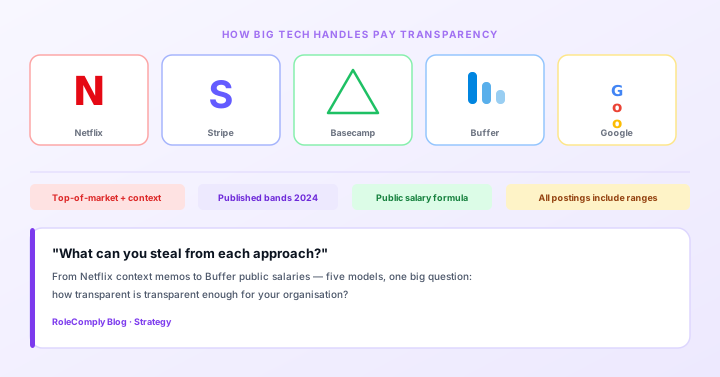
Netflix's culture document has long been explicit that the company pays "top of market" and that employees should periodically interview at competitors to understand their market value. Netflix's approach: pay individuals enough that they are not financially motivated to leave, communicate this policy clearly, and avoid the secrecy that breeds resentment.
Netflix uses a single compensation number (base salary, no bonus structure for most roles) and pays in the top 10th percentile of market. Internally, the approach requires a rigorous and constantly-updated view of market compensation — which means Netflix's HR function runs more like a compensation analytics operation than a traditional rewards team.
What to adapt: Even if you can't pay top-of-market, the principle of clarity about how you position compensation (and why) is powerful. Candidates and employees who understand and accept the rationale are less likely to leave over pay.
Stripe: Level-based pay bands with internal transparency
Stripe uses a structured levelling system (L1–L9+) with defined pay bands for each level. These bands are shared internally — employees know the range for their level and the level above. Job postings include salary ranges as required by applicable law.
Stripe's approach treats levelling as the primary compensation mechanism. Getting levelled correctly at hiring — and advancing levels — is the primary way to move up in compensation. This reduces ad-hoc negotiation and creates more equitable outcomes across demographic groups.
What to adapt: If you don't have a formal levelling system, a simplified version (3–4 levels per function) creates significant pay equity benefits and makes posting salary ranges much simpler — the range follows from the level.
Basecamp: The formula approach
Basecamp (now 37signals) has published their salary formula publicly for years. They pay a fixed salary based on role and seniority, benchmarked to the top 10% of San Francisco market rates — for everyone, regardless of where they live. The exact salaries are published on their website.
This is radical transparency: any candidate can look up exactly what they would be paid before applying. There is no negotiation — the formula determines the salary. The result is that Basecamp attracts candidates who value simplicity and fairness over negotiation upside, and eliminates pay inequity entirely.
What to adapt: The formula approach is most practical for smaller companies with clear role definitions. The principle of publishing actual salaries (not just ranges) dramatically reduces friction in recruiting and eliminates pay equity risk.
Buffer: The public salary spreadsheet
Buffer has maintained a publicly accessible spreadsheet of every employee's salary since 2013. Any member of the public can see what any Buffer employee earns. The company argues this creates accountability for pay equity, builds trust with candidates, and forces the organisation to be deliberate about its compensation decisions.
What to adapt: Full salary publication is not right for most companies. But the underlying principle — that your compensation decisions should be able to withstand public scrutiny — is a useful test when making pay decisions.
Google and Microsoft: Compliance plus
Both companies post salary ranges in all job postings, regardless of whether the role requires it — treating transparency as a global standard rather than a minimum. For roles in regulated jurisdictions, ranges are detailed and specific. For roles in unregulated markets, ranges are still included. Both companies have faced pay equity enforcement actions and have invested significantly in internal pay equity analysis as a result.
What to adapt: Applying your transparency standard universally — not just where required by law — signals that your approach is principled, not merely compliant.