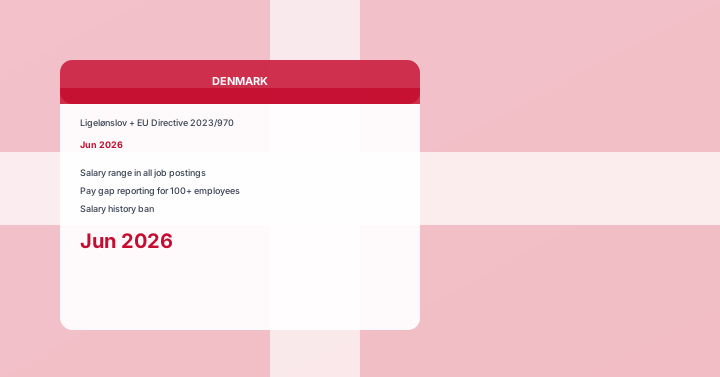
This guide covers pay transparency requirements for employers operating in or hiring from Denmark under the EU Pay Transparency Directive (2023/970/EU) and existing national legislation. The EU Pay Transparency Directive (2023/970/EU) requires all 27 member states to transpose its requirements into national law by June 7, 2026. The Directive mandates that employers disclose salary ranges in job postings, prohibit salary history inquiries, and report pay gap data for larger organisations. See the full EU Directive guide for the complete framework.
Current status in Denmark
Who does this apply to?
- Employers with operations in Denmark or posting roles accessible to Denmark-based candidates
- Employee threshold for Directive obligations: All employers
Job posting requirements
- Salary range: Salary range in job postings required from June 2026
- Salary history ban: Prohibited under Directive
- Pay gap reporting: Employers with 35+ employees must file annual pay statistics with Statistics Denmark
Denmark's pay statistics requirement
Danish employers with 35 or more employees have long been required to file pay statistics with Statistics Denmark, broken down by gender. The EU Directive now adds job posting transparency requirements — salary ranges in all advertisements. Danish HR teams should prepare posting workflows ahead of the June 2026 deadline while maintaining pay statistics obligations.
Employer checklist for Denmark
- ✓ Include salary range in all job postings for Denmark-applicable roles
- ✓ Remove salary history inquiries from applications and interviews
- ✓ Understand your pay gap reporting obligations under the Directive
- ✓ Brief recruiters on the requirements for roles in Denmark
How RoleComply helps
RoleComply checks every posting for Denmark compliance — whether you're operating there directly or hiring remote workers based in Denmark. As the Directive's transposition deadline approaches, RoleComply's scanning rules update automatically to reflect each country's enacted legislation, so your team doesn't need to track individual national laws.
What the EU Directive means for Denmark employers
The EU Pay Transparency Directive (2023/970/EU) sets binding minimum standards across all 27 member states. For employers in Denmark, it builds on existing national law — Ligelønslov — and introduces new obligations that will apply once Denmark transposes the Directive by 7 June 2026.
The core requirements are: mandatory salary range in every job posting, a ban on salary history questions, the right for employees to request pay gap comparisons, and mandatory pay gap reporting for employers with 100 or more employees. The European Commission pay transparency guidance and the Danish Ministry of Employment are the authoritative sources for Denmark-specific implementation details.
Practical steps for Denmark employers
Audit every job posting now. Review all roles advertised in Denmark across your careers page, LinkedIn, local job boards, and any recruitment agencies posting on your behalf. Every posting needs a salary range once the Directive is transposed — starting the audit now means you are ahead of the deadline rather than reacting to it.
Build a pay banding framework. The Directive requires ranges to reflect objective, gender-neutral criteria. This means a structured compensation system: roles mapped to levels, benchmarked against market data, with documented factors for variation within each band. Without this foundation, you cannot post defensible ranges.
Prepare for pay gap reporting. Employers with 100 or more employees in Denmark will need to calculate and report their gender pay gap. Unlike equal pay analysis (which compares pay for identical work), pay gap reporting looks at average pay across your entire workforce. Start tracking pay, role, and gender data now.
Train HR and recruiters. Front-line teams need to know that salary history questions are banned, that vague phrases like "competitive salary" are prohibited, and that every posting needs a real range — not a placeholder. Run a short briefing and update your posting templates before the deadline.
Penalties
The Directive requires Denmark to establish "effective, proportionate and dissuasive" penalties. Employers found to have pay discrimination face reversed burden of proof: once a complaint is raised, the employer must demonstrate their pay practices are lawful. See our full EU Directive guide for the complete framework, or read our pay transparency 101 guide for the broader context.