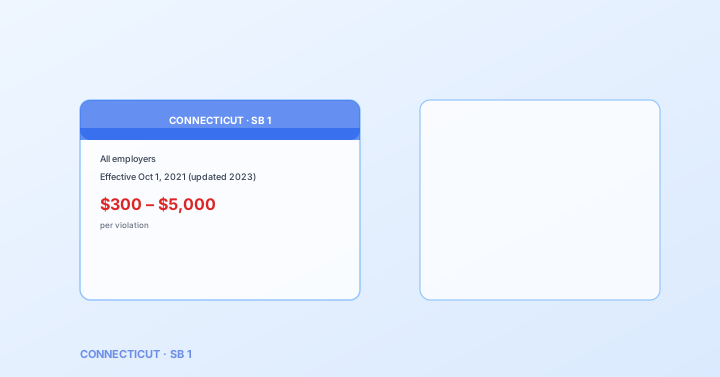
Connecticut was an early mover on pay transparency, enacting SB 1 in 2021 and subsequently strengthening it with additional requirements. Connecticut's law applies to all employers regardless of size and includes both job posting requirements and employee rights to request pay range information.
Who does Connecticut's law apply to?
Unlike most state pay transparency laws, Connecticut's law applies to all employers — there is no minimum employee threshold. Any employer operating in Connecticut or hiring for roles that can be performed there must comply.
What are the posting requirements?
Connecticut's requirements evolved in two stages:
Original 2021 requirement (SB 1)
- Employers must provide the wage range for any advertised position upon request by an applicant
- Must provide wage range to current employees for their own position upon request
- Cannot rely on prior salary history to set compensation
Updated 2023 requirements
- Employers must now include the wage range and description of benefits directly in job postings — not just upon request
- The wage range should represent what the employer in good faith believes it may pay for the position
Salary history prohibition
Connecticut prohibits employers from requesting or screening applicants based on salary history. This applies statewide to all employers and is enforced alongside the pay transparency requirements.
Employer checklist
- ✓ Include wage range and benefits description in all public job postings
- ✓ Remove salary history inquiries from applications and interviews
- ✓ Respond to employee requests for wage range information for their position
- ✓ Applies to all employers regardless of size — no minimum threshold
How RoleComply helps
RoleComply checks Connecticut job postings for wage range and benefits inclusion. Because the law applies to all employers without a size threshold, even smaller companies with Connecticut postings need to be vigilant. RoleComply catches non-compliant postings before they trigger complaints.
What Connecticut employers must do
The Public Act 21-30 requires employers to include salary ranges in job postings in Connecticut. The Connecticut Department of Labor is the authoritative source for compliance guidance and enforcement updates. Employers with any hiring activity in Connecticut should treat pay range disclosure as non-negotiable.
Audit every active posting. Review all roles advertised in Connecticut — on your own careers page, LinkedIn, Indeed, Glassdoor, and through any staffing agencies. Every posting needs a salary range. Check that your range is genuine — regulators and candidates alike can identify placeholder-wide ranges that bear no connection to actual pay.
Establish pay bands. A range on a job posting is only defensible if it connects to a documented compensation structure. Build pay bands for each role or level, benchmark against market data, and document the factors that explain variation within each band (experience, skills, location). This documentation protects you in enforcement situations and in employee conversations.
Train your recruiting team. Front-line recruiters need to understand what is required and what is prohibited. "Competitive salary", "DOE", salary history questions, and ranges that do not match the actual hiring budget are the most common violations — and all of them are preventable with basic training and updated posting templates.
Penalties and enforcement
Enforcement of US pay transparency laws has accelerated since 2023. New York City has issued fines ranging from $15,000 to over $250,000 for single violations. California's Civil Rights Department investigates complaints and requires remediation. The pattern is consistent across jurisdictions: initial enforcement targets large employers with visible non-compliance, then expands to mid-market companies as regulators build capacity. See our US state law roundup for current requirements across all states, or read our salary range best practices guide to learn how to write ranges that satisfy multiple state requirements simultaneously.