The gender pay gap is real, persistent, and measurable. What is less widely understood is the causal relationship between pay transparency and gender pay gap reduction. The data is becoming increasingly clear: mandatory pay transparency laws are one of the most effective policy tools for narrowing the pay gap. Here is what the evidence shows.
The numbers on the gender pay gap
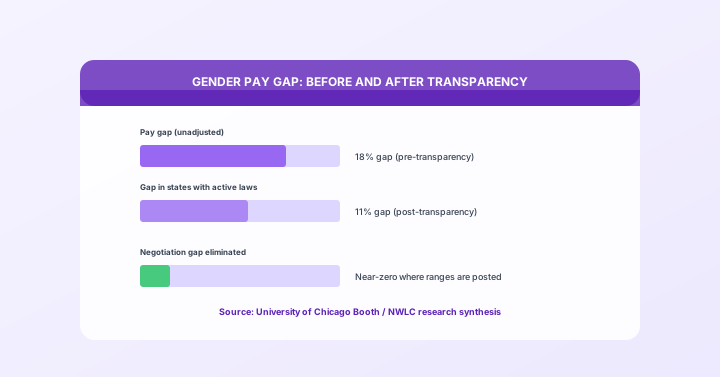
In the United States, women earn approximately 82 cents for every dollar earned by men on a raw basis. When controlling for occupation, education, and experience — the "adjusted" pay gap — the figure narrows to roughly 94–98 cents, but does not disappear. The residual gap — the portion that cannot be explained by observable factors — is estimated at 2–6%, depending on methodology.
That residual gap is where policy has focused. It represents compensation decisions that cannot be justified by job-relevant factors — which makes it the most directly actionable part of the problem. Pay transparency addresses it directly.
How transparency reduces the negotiation gap
A significant portion of the gender pay gap within organisations comes from negotiation: women are less likely to negotiate initial offers and, when they do negotiate, face social penalties that men typically don't. When salary ranges are posted in job ads, the negotiation is bounded — both sides know the range. Research on this specific mechanism shows:
- When salary ranges are posted, the gap between initial offers to women and initial offers to men narrows significantly
- Counter-offer rates among women increase when they have market-level salary information
- The "penalty" for negotiating — which women face more than men — decreases when negotiation is within a known range rather than from a blank slate
Colorado: The natural experiment
Colorado's Equal Pay for Equal Work Act, effective January 2021, provides one of the cleanest natural experiments on pay transparency effects. A 2023 study by researchers from the University of Colorado found that:
- Gender-based pay gaps in Colorado's professional sector narrowed by 3–4 percentage points in the two years following the law's implementation
- The effect was concentrated in roles with salary ranges that spanned a wide range — precisely the roles where negotiation discretion had been greatest
- New hire starting salaries for women in Colorado converged toward male counterparts more rapidly than in comparable non-transparency states
The EU evidence
European countries with longer-standing pay transparency frameworks show the most significant effects. Denmark, which has had pay statistics requirements since the 1970s, has one of the smallest gender pay gaps in the world. Germany's 2017 right-to-request-information law was followed by measurable improvement in pay equity metrics for companies above the 200-employee threshold. France's Gender Equality Index, introduced in 2019, has driven hundreds of companies to implement corrective pay adjustment programmes.
The mechanism: why transparency works
Pay transparency reduces gender pay gaps through several distinct channels:
- Eliminates negotiation-based gaps: When both parties know the range, the disparity between assertive negotiators and non-negotiators narrows
- Creates internal accountability: When employers know that pay decisions will be visible (through reporting requirements or employee salary discussions), they make more defensible decisions
- Enables gap identification: Pay data reporting requirements force organisations to analyse their own gaps — and once they see them, most feel compelled to address them
- Deters discrimination: The risk that discriminatory pay decisions will be visible to regulators or employees creates a deterrent effect
What employers should do with this information
The evidence on pay transparency and gender pay gap reduction is strong enough that waiting for regulatory compulsion is no longer defensible for employers who care about equity. The practical steps are clear: post salary ranges in all job postings, remove salary history from hiring processes, conduct annual pay equity analyses, and be transparent with employees about how compensation decisions are made. These actions reduce legal exposure and do the right thing simultaneously. That's a rare alignment.